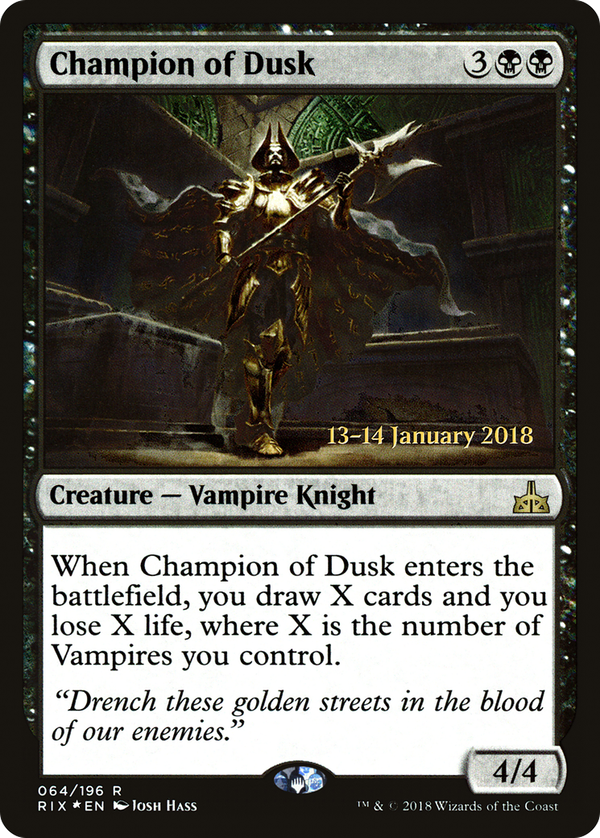
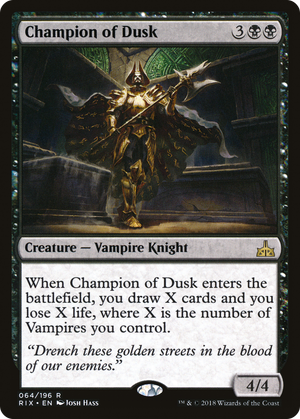
Champion of Dusk


Black has always paid for card advantage in life, but the scaling here is the wrinkle: the refill is proportional to the board you already built, which inverts the usual draw-for-life math. Because the 4/4 body counts itself, the floor is always at least one card and one life; the ceiling arrives when it enters a developed Vampire board, drawing a full hand and bleeding you for a chunk of life you can usually spare against decks too slow to punish it. That self-mirroring quality (the card rewards the deck that least needs more gas and offers almost nothing to the deck that does) makes it a payoff rather than an engine. It belongs to the lineage of black mass-draw effects in the vein of Promise of Power and Ambition's Cost, but unlike those it ties the size of the windfall to a tribal count, so the deckbuilding cost is paid up front in committing to the Vampire theme rather than in the mana. The tension the design has to manage is that the life loss is symmetric with the draw, so the player who profits most also exposes themselves most: a tribal deck that overextends into it can draw a hand it cannot survive, paying itself to death. That is the discipline the effect asks for, and it is the whole reason the card stays fair.