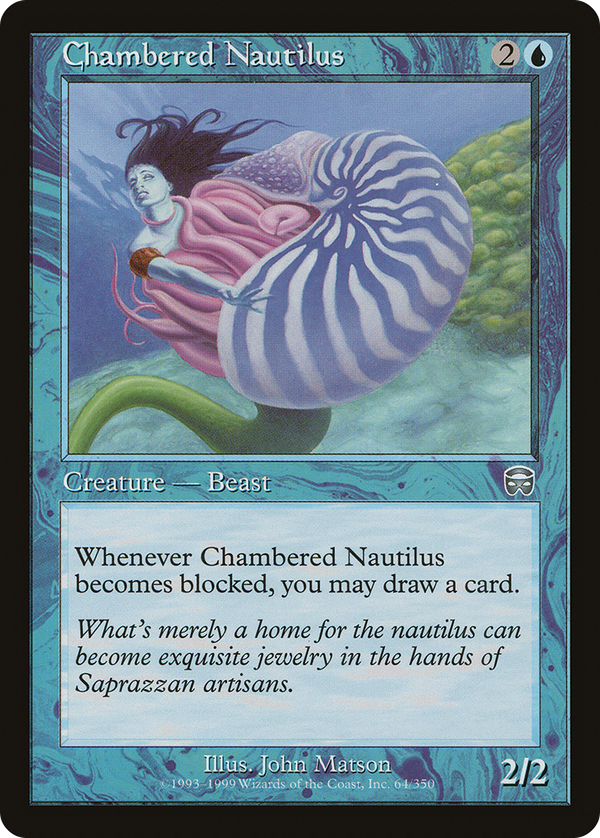
Chambered Nautilus


The reward attaches to the moment of being blocked, which makes the card a small wager on the opponent's combat math: every point of damage they want to stop comes packaged with a card you get to draw. That puts the decision on the defending player, not the attacker, a quietly elegant inversion of how blue usually buys card advantage. Most blue draw is paid up front at sorcery or instant speed; here the cost is borne by an opponent who has to choose between eating two damage and handing you a fresh card. Against a deck that wants to trade evenly in combat, the trigger taxes every block; against a deck content to take the hit, the body just keeps swinging. Two things hold the design in check: a 2/2 that an opponent can ignore entirely if they would rather not feed it, and a "may" clause that prevents awkward forced draws. The idea of creatures that convert combat into cards is one Wizards has revisited in various shapes, usually with a bigger body or evasion stapled on to force the question. This is the stripped-down version of the template: no evasion, no protection, just a modest attacker asking the opponent to decide whether stopping it is worth the information it hands back.