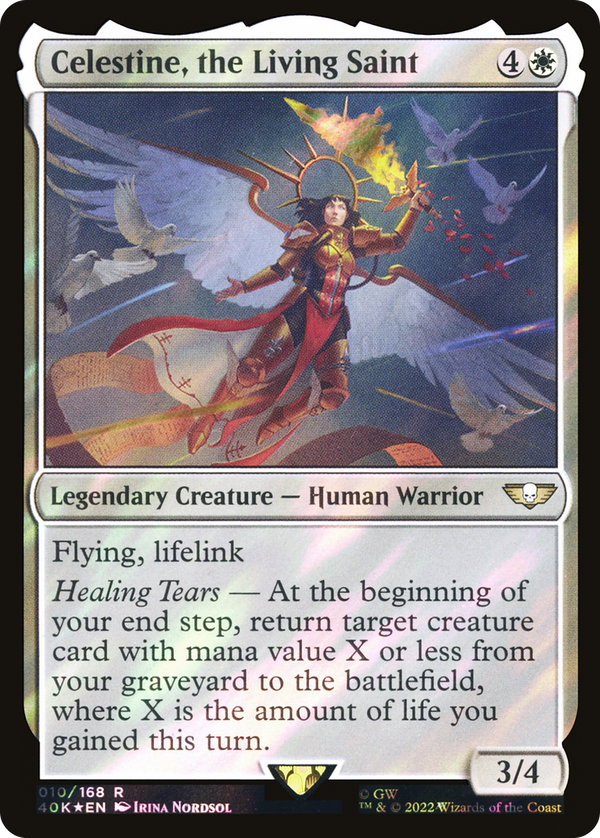
Celestine, the Living Saint


Lifegain has always been the payoff mechanic that struggles to pay off: the life total ticks up, and then what? Healing Tears answers that by converting gained life into a recursion budget. Every point of life you accrue in a turn raises the ceiling on what walks back out of your graveyard at the end step, so the lifelink on the body is not incidental flavor but the fuel line feeding the reanimation. Attack with the lifelink body alone and you gain three, setting X to three; that end step you return a creature card of mana value three or less. The engine compounds, since each reanimated body can gain more life the following turn, ratcheting the recursion cap upward.
The design discipline is in the timing and the ceiling. The trigger reads life gained this turn, not a running total, so a turn where nothing gains you life caps X at zero, limiting you to a mana value zero creature: the card demands you do the lifegain work each cycle rather than bank it. Because X is capped by a single turn's gain, the effect rewards a board built to gain aggressively rather than one big swing. White has a long line of recursion engines that ask you to construct a graveyard worth returning from (Sun Titan pulls low-cost permanents, Karmic Guide loops single creatures), but the lifegain constraint gives it a distinct axis: the reach of the reanimation is something you assemble across the turn, not a fixed value printed on the card.