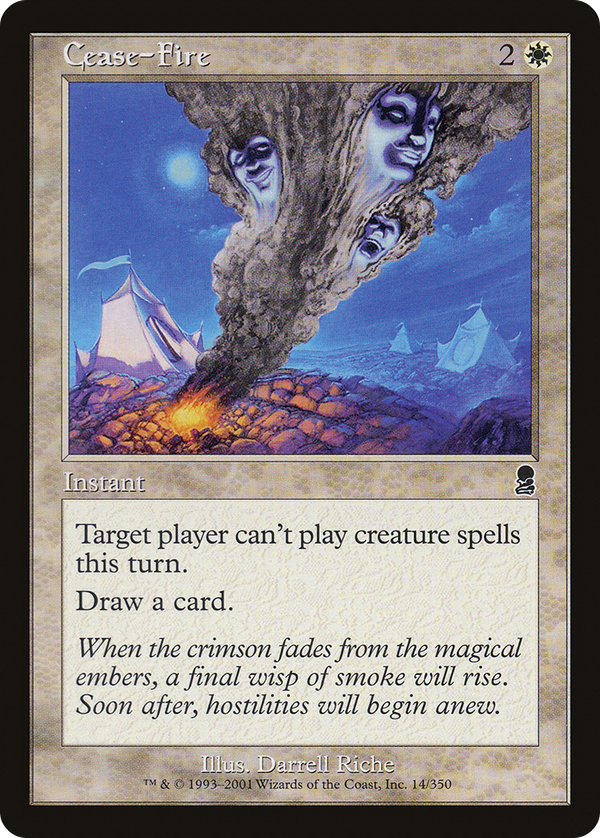
Cease-Fire


Disruption that targets a category instead of a single object. Most counterspells answer a spell already on the stack; this answers a strategy before it forms, denying an opponent a full turn of creature development without ever touching a specific threat. The timing runs backward from how players usually reach for disruption. You cannot wait for the all-in turn and respond to it, because the spell does not counter anything: it shuts the door on creature casting entirely, and to matter it has to resolve while the would-be caster holds priority, typically during their upkeep or draw step, before they can spend the turn dumping their hand. Read the moment right and the planned curve-out simply never happens: the threats stay stranded in hand for a turn. Read it wrong, and you have paid for a cantrip that did nothing. That conditionality is severe, and it is what keeps the card at the margins. Against a player who has already committed a board, the lock clause is inert; the creatures in play attack as scheduled, and the card draw is all you are left with. The pitch is preemption rather than cleanup: not a sweeper like Wrath of God that resets a developed board, not a Fog that buys one combat, but a denial that forecloses development before it begins. The card draw is the concession built in to soften a guess that, by design, can miss the window entirely.