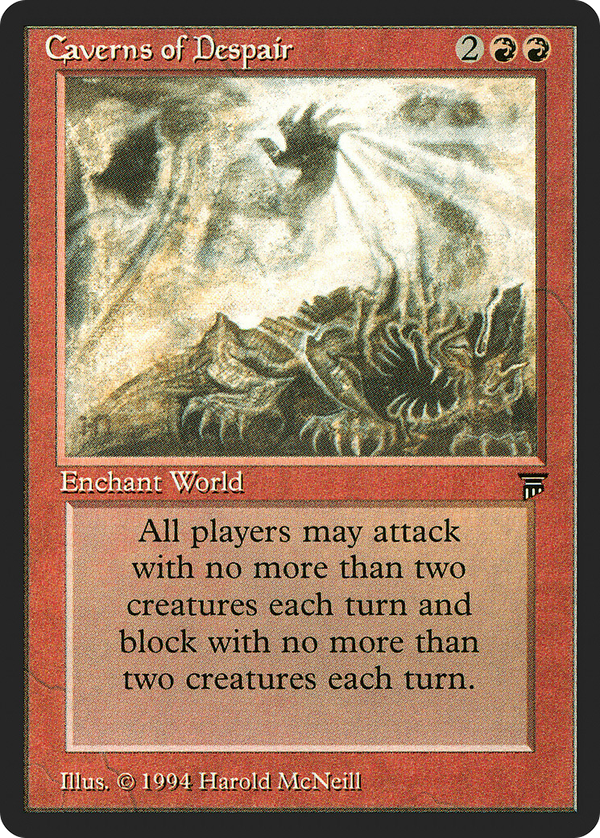
Caverns of Despair


Combat math, rewritten at both ends. Capping attackers at two neutralizes the wide board (token swarms, weenie rushes, anything trying to convert a count advantage into damage), while capping blockers at two protects the trampler, the evasive threat, and the big attacker who would otherwise drown in chump blockers. The asymmetry is the whole design: a deck built around one large creature gets through almost untouched against a deck of six small ones, and the player who resolves the enchantment decides which side of that trade they want to live on. Four mana in red is a strange home for a combat-locking piece (red is usually the color begging for more attackers, not fewer), but Legends was full of these off-axis color assignments, where the flavor of narrow mountain passes outranked the strategic fit. As a World enchantment it carried the supertype's single-copy rule, so the shared game state belonged to whoever last put one onto the battlefield. That supertype was largely abandoned as a design tool by the late nineties, leaving a small museum of cards like this one: rules-text experiments dating to a stretch when the boundaries of what a permanent could legally impose on the shared board were still being drawn.