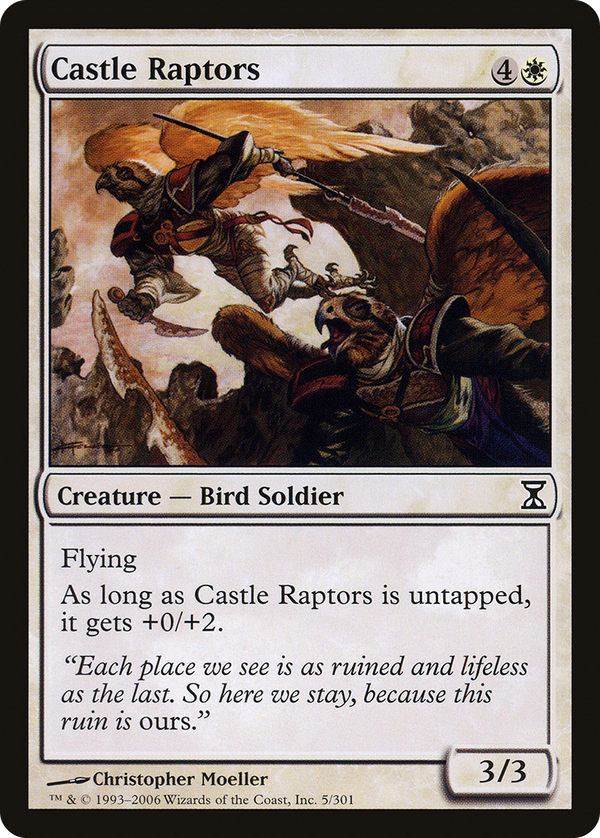
Castle Raptors


The toughness bonus exists to break the most fundamental tradeoff in combat: attacking normally leaves you weaker on defense. Here the math runs backward. The body that holds the ground is a 3/5, but the instant it commits to the air it taps, shrinks to a 3/3, and cannot block that turn at all. So the card quietly argues against its own evasion: the natural instinct with flying is to send it in, and this design rewards patience instead, asking the controller to choose turn by turn between a three-point aerial clock and a stubborn wall. The interaction with vigilance is the obvious tension. Granting it vigilance would let it attack while staying untapped, keep the +0/+2, and sidestep the entire constraint, which is presumably why it was never natively paired with one. The conditional is the whole game. Left home and untapped, it polices the skies as something an opponent's fliers cannot profitably trade into; sent in, it is a plain 3/3 that has surrendered its defense for the turn and faces blockers as that smaller body. The swing makes it a slightly awkward read in combat not because the attacking size differs from the connecting size (it does not: a tapped attacker is a 3/3 from declaration through damage) but because the defensive profile and the offensive profile are two different creatures sharing one card, and only one of them exists at a time.