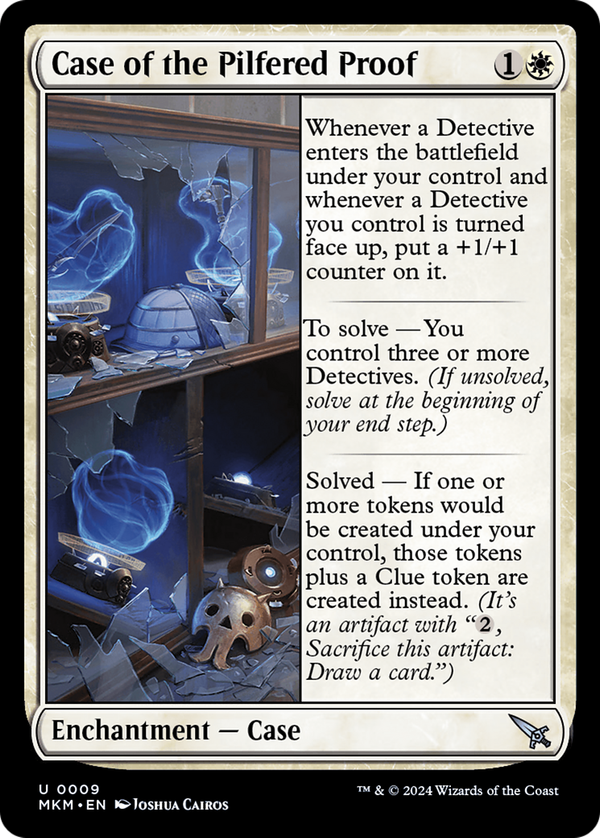
Case of the Pilfered Proof


The Case mechanic's whole trick is that it front-loads a passive reward and back-loads a payoff, and this one wires both to the same tribal engine. The passive alone is a tempo-positive proposition: every Detective that walks in or flips face up gets bigger, so an aggressive white creature deck that skews toward the type is quietly stapling counters to its board for a single card's investment. The solve condition asks you to commit to that plan (three Detectives is a real board state, not an incidental one), and pays it off by bending your token production into card advantage. Once solved, any token you'd make comes with a Clue riding shotgun, which turns a go-wide creature deck into a slow card-draw machine that never stops earning while the counter engine keeps ticking. The structural cleverness is that the two halves reinforce the same axis: you want a wide, Detective-heavy board for the counters, and a token-heavy deck maximizes the solved bonus, so the deck that satisfies the front half is already most of the way to satisfying the back. It is a Case that rewards the exact deck it was drawn for rather than asking you to warp around it, and the Clue clause makes the reward compound rather than resolve once.
Rules text
 , Sacrifice this token: Draw a card.")