Case of the Crimson Pulse


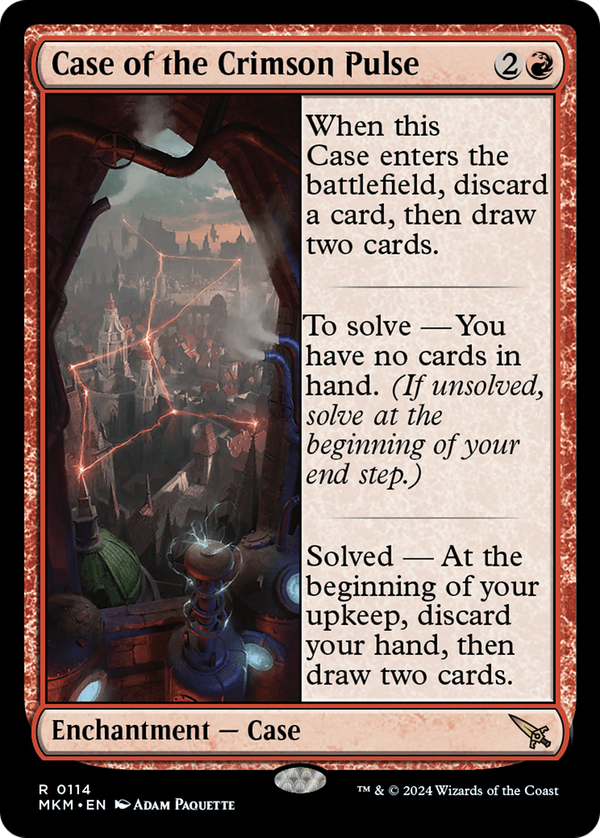
Red rarely gets card advantage without a cost, and the way this one prices its draw defines everything about how it plays. The entry mode is a controlled loot: pitch one, draw two, a familiar smoothing effect. The trick is the solve condition. Emptying your hand is trivial for the deck this was built for, and once solved the enchantment becomes a recurring upkeep engine: discard whatever hand you have, then draw two, every turn, unconditionally. That unconditional discard is the balancing act. If you sit on answers, the engine simply throws them away before refilling, so the card punishes the durdle player who wants to bank cards and rewards the pilot who spends down to zero on their own terms before the trigger resolves. The refill is only a net gain if you have already cashed out, which turns the whole thing into an incentive to play fast and flat rather than a raw advantage machine. It sits in the lineage of red's hand-refresh effects that ask you to prove you have nothing left to lose, closer to a personal wheel on a repeatable clock than to a straightforward card-draw enchantment. The Case framing (a puzzle you solve by reshaping your board state, then bank a permanent upgrade) gives red a scarce permanent-based engine, one that lives or dies on whether your deck is built to want an empty hand every turn rather than fear one.