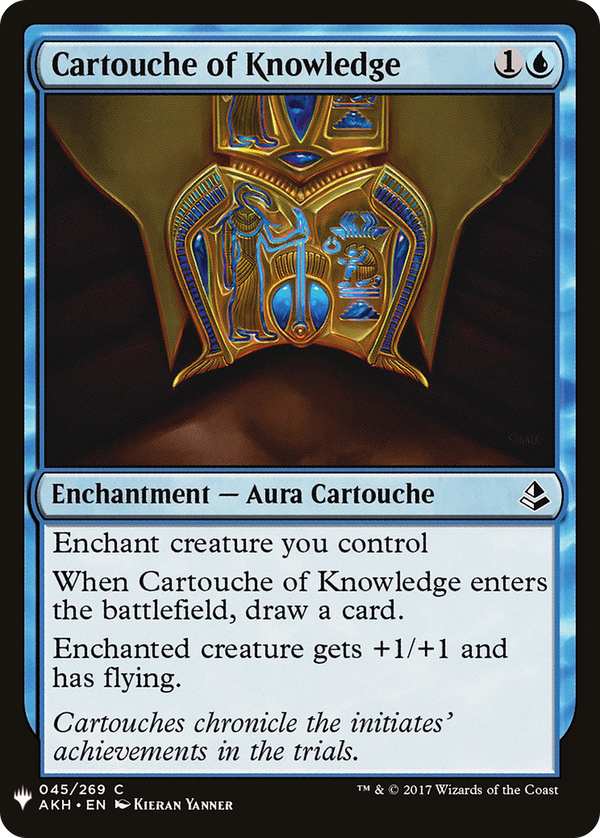
Cartouche of Knowledge


The trick to evaluating an Aura that replaces itself is to net out the card economy: spend a card to enchant, draw one on entry, and you are back to even, with the enchanted creature now carrying +1/+1 and evasion for the price. That cantrip clause answers the objection that killed the long line of card-disadvantageous combat Auras: for decades a creature wearing an Aura was a two-for-one waiting to happen, and players learned to leave the archetype alone. The protection here is narrower than it looks, though. If the targeted creature dies in response to the Aura, it has no legal target and is removed from the stack without resolving: the draw never triggers, and you eat the full two-for-one anyway. The card economy only balances when the enchant actually lands. Flying is the operative word: a ground creature that suddenly attacks over the top changes the math of a stalled board far more than a raw stat boost would. As a sorcery-speed Aura, it commits during your main phase rather than ambushing a combat in progress, so the correct play is to build the evasive threat ahead of the swing, not to spring it. The Cartouche subtype ties it to a Trial cycle built around stacking enchantments on a single creature, but the design lesson predates that synergy: an Aura earns its slot when it carries its own replacement, and the +1/+1-and-flying line is the rare aggressive Aura that pays back the card you spent. Strip the tribal hooks and you are left with clean blue tempo.