Carnival of Souls


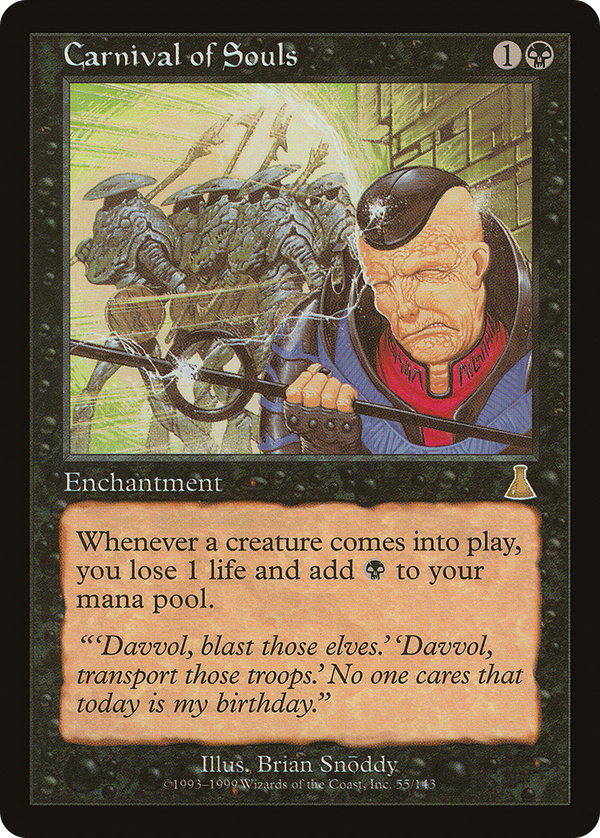
The trap is the symmetry, and the design knows it. Every creature that enters generates black mana for you, but the trigger fires for opponents' creatures as freely as your own, and each one costs you a life. That is the friction the rate is built around: this is not a ritual you tap on demand but a tax on the whole board state, and the life loss compounds in exactly the games where you can least afford it. The reward for building around it is severe, because the floating black mana arrives whether you have a use for it or not, meaning the engine wants a sacrifice loop or a creature-spam shell that can dump bodies fast enough to convert the mana before the bleed catches up. Pair it with a token engine and a sacrifice outlet that recurs creatures, and the mana and the life payment turn into a combustion chamber: each cycle pays for the next until something gives way. Without that scaffolding it is a slow drain that floods you with mana you cannot spend and life you cannot spare. It belongs to the small family of enchantments that turn creatures-entering into a fungible resource, a precursor to the mana-and-life economies that aristocrats decks would later formalize. The card asks a hard question of any deck that runs it: can you spend the mana faster than the life total runs out, given that the loss lands on you and nowhere else.
Rules text
.