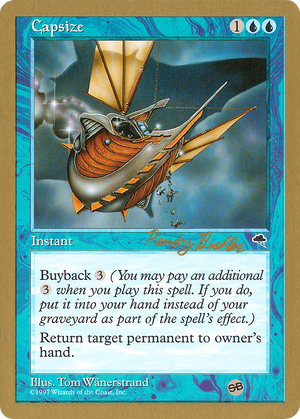
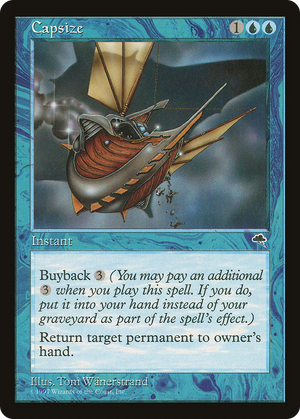
Capsize


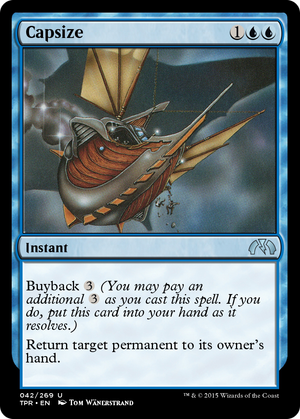
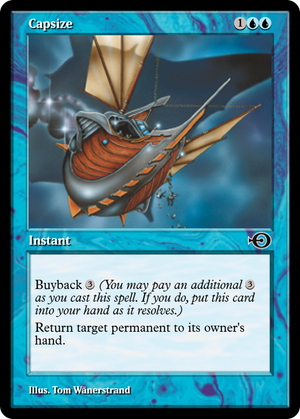
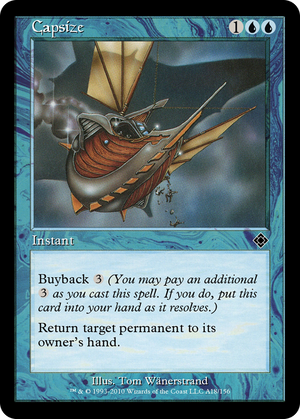
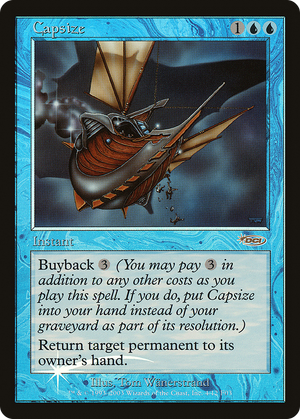
The clearest demonstration of buyback's whole design conceit: a spell that refuses to leave. Strip the keyword away and you have a slightly overcosted Boomerang, a one-shot tempo play. Pay the surcharge and that one-shot becomes an engine, because the spell comes back to your hand as it resolves. Every turn you untap, pick off a land, a creature, an artifact, anything, and the card waits in hand to do the same the following turn. The mana floor is the balance lever. Buyback refunds the spell, not the cost, so a repeatable cast demands a heavy commitment each turn, and what that commitment buys is bounce rather than removal: the permanent returns, it is never actually dealt with. That gap between "perpetual" and "permanent" is the entire design tension. Capsize does not win on its own; it locks. Point it at an opponent's only land and they never untap with mana again; chip their board apart piece by piece while a clock ticks elsewhere. It is the archetypal soft-lock tool, proof that you do not need to answer a problem once if you can answer it every single turn. Buyback as a mechanic was built to ask whether reusability was worth a premium; Capsize is the answer that showed how dangerous the question could get.
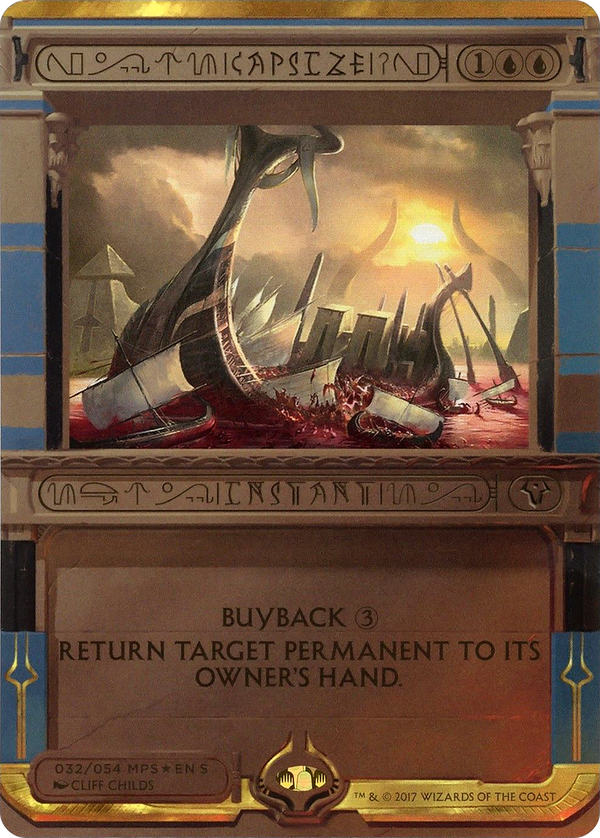
Rules text
 (You may pay an additional as you cast this spell. If you do, put this card into your hand as it resolves.)
Return target permanent to its owner's hand.
(You may pay an additional as you cast this spell. If you do, put this card into your hand as it resolves.)
Return target permanent to its owner's hand.