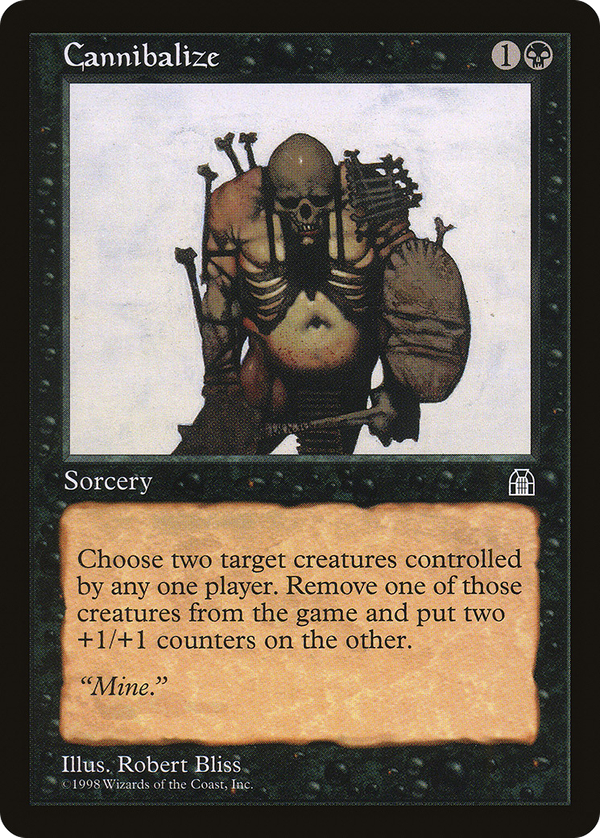
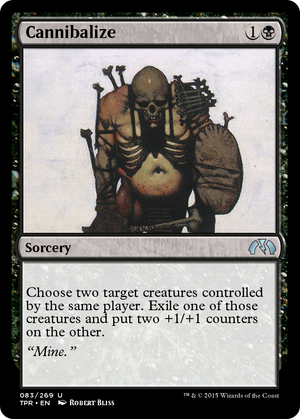
Cannibalize


Both targets must belong to the same player, and that single restriction defines everything the spell can and cannot do: it never separates one of your creatures from one of theirs. Aimed at your own board, it is a pump spell that eats a body, exiling a redundant token or a spent utility creature to dump two +1/+1 counters onto something already worth attacking with. Aimed across the table, it becomes removal with a catch, because the same restriction forces both targets onto the opponent's side: you exile their best creature, but the two counters land on whatever they have left, so the spell wants them holding a real threat alongside a body so harmless that growing it does not matter. The exile is the load-bearing word in both readings: a creature removed this way never reaches the graveyard, so it never feeds the recursion, death triggers, or reanimation that black usually wants left on the table. That is a pointed instruction for a color built around death as a resource, because nothing here is sacrificed; the loss is total and triggerless. What you actually evaluate each cast is which board can spare a body, and whether the counters land somewhere that shortens a clock faster than the exiled creature was worth, or somewhere irrelevant enough that the gift costs nothing. The friction lives entirely in that arithmetic.