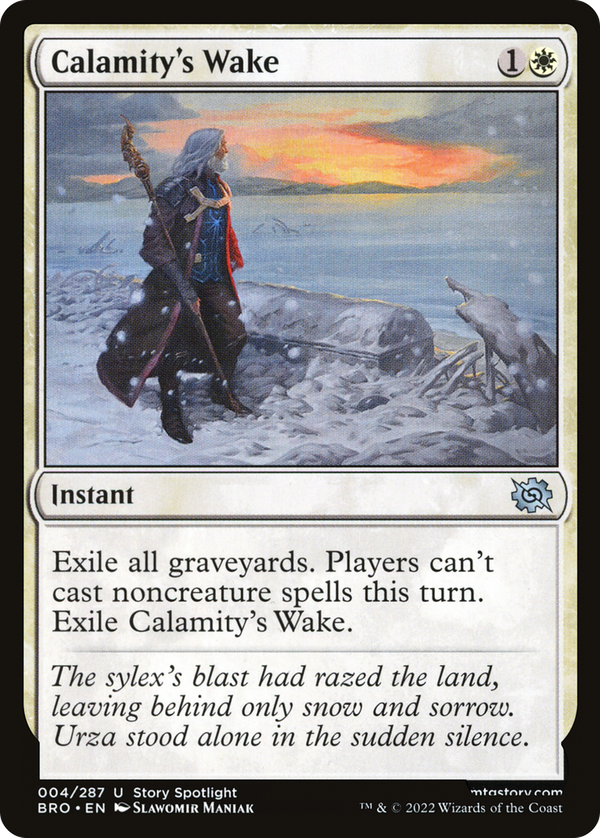
Calamity's Wake


Most graveyard hate ends its own turn: it exiles the yard and then hands priority back, and while it is on the stack the graveyard deck gets one last window to escape a spell, flash back a threat, or fire a recursion trigger before the exile ever resolves. The second clause is the design that seals off the aftermath. Once this resolves, no player can cast noncreature spells for the rest of the turn, so a deck that just lost its yard cannot rebuild from what remains: no instant-speed recursion off the top of the library, no holding up a counter, no fighting over anything until the turn ends. The exile-all-graveyards line is symmetrical and total, which matters against escape and delve engines that treat the yard as a second hand, but the noncreature lockout is what turns a plain resource-denial spell into tempo denial. Resolve it on the opponent's turn and they can't cast noncreature spells for the rest of that turn. The cost of that reach is symmetry: you also go quiet on noncreature spells, so it wants a creature-forward shell that loses nothing by pointing the lockout only at them. The window to respond exists only while the spell is on the stack, before resolution; the lockout is a consequence of resolving, not a shield around it. The self-exile clause is a small anti-recursion detail that keeps the effect from being bounced back for a repeated lock.