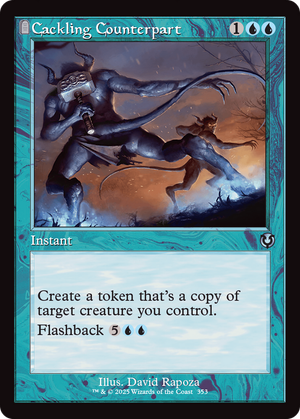
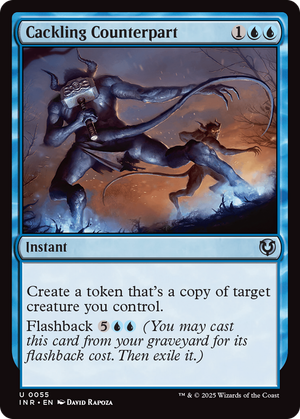
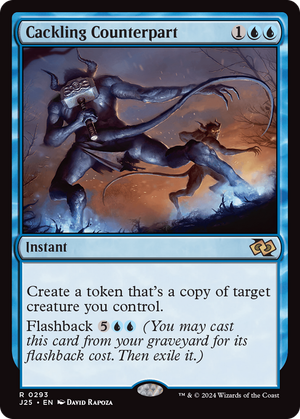
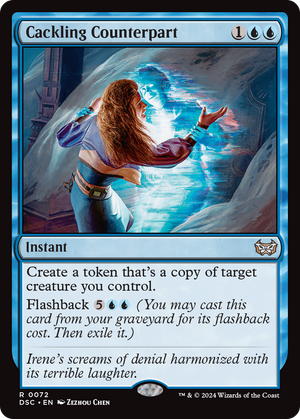
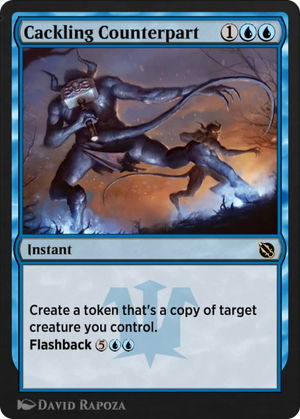
Cackling Counterpart


Clone effects had long been priced as creatures: you paid the body's mana, and the copy walked into the same removal that kills anything else. Putting the effect on an instant changes which window you're playing in. Held up at end of step, in response to a removal spell on a key creature, or after combat math has resolved, this turns a copy into a reactive play rather than a development one. The target restriction (a creature you control) narrows the rate against open-ended clones like Clone or Phantasmal Image, but it also locks in the upside: you copy your best enters-the-battlefield trigger, your best attacker, your best engine piece, on your terms and at the moment it matters most. Flashback is the part that lifts it from clever to recurring. A clone that comes back wants a board worth duplicating twice, and it rewards decks that have already built a creature worth copying once. The friction is the cost stack: the original cast is sharp, the graveyard cast is deliberately heavy, so the second copy is a late-game payoff rather than a free repeat. What the card represents is the instant-speed flicker of a closed design space: a copy spell that stopped pretending to be a creature and started behaving like a trick.
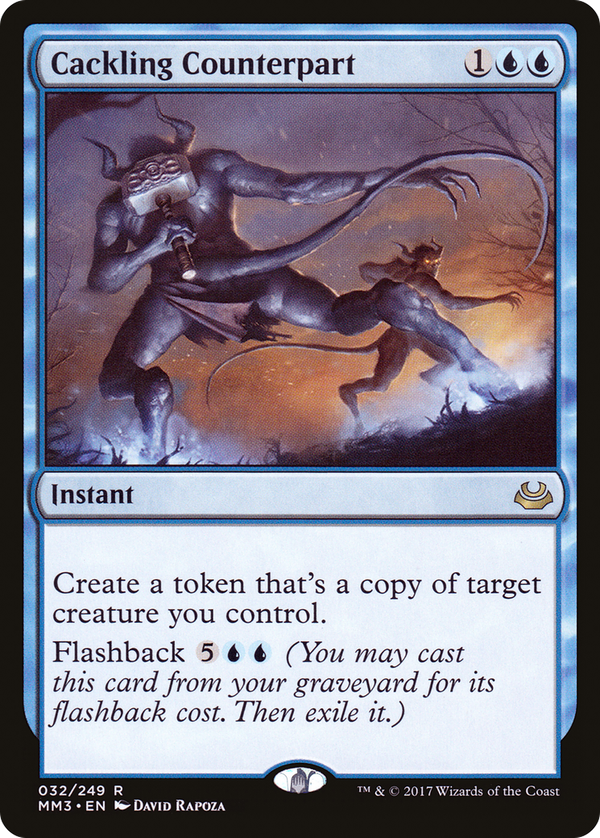
Rules text
 (You may cast this card from your graveyard for its flashback cost. Then exile it.)