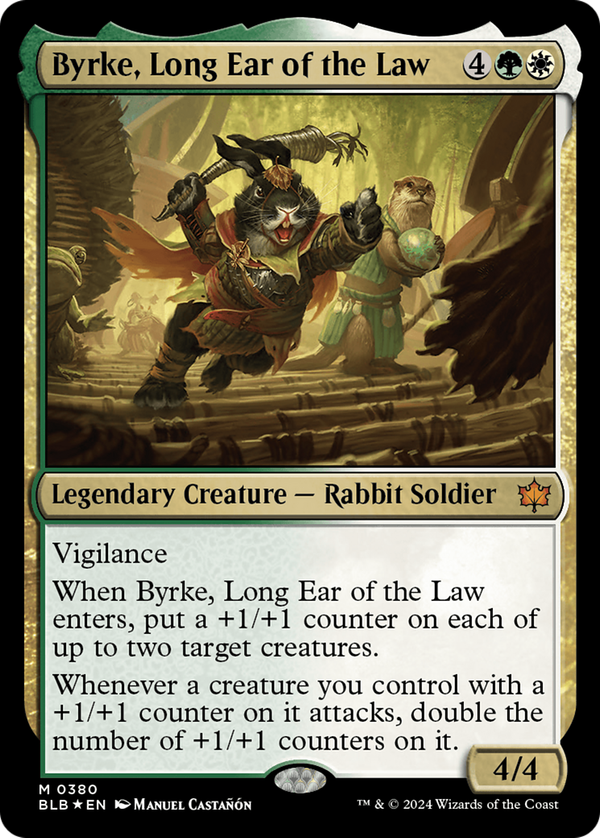
Byrke, Long Ear of the Law



Counters have always compounded slowly: you add one at a time, and the arithmetic climbs by increments. This flips the growth curve from addition to multiplication. The entry ability seeds the board with up to two counters, and from there every attack from a counter-bearing creature doubles what is already there, so the second swing is worth more than the first and the third dwarfs both. A creature with a single counter attacking three turns running does not gain three; it goes one, two, four, and the exponential math outruns any incremental buff a comparable card could offer. The doubling trigger fires on the attack step rather than on any tap-out cost, so a creature already carrying a counter cashes its multiplier the moment it is declared as an attacker. The design discipline is that the trigger only fires for creatures you control that already carry a counter, so the payoff is bounded by how well you seed and spread counters rather than being a free board-wide steamroll. That makes the deckbuilding question specific: not "how big can one creature get" but "how many attackers can I keep counter-loaded turn after turn," since each one on that clock compounds independently. The vigilance sits on the body itself, keeping the commander available to block while the rest of the board races: a counters-matter payoff that finally cares about velocity over volume.