Budoka Pupil // Ichiga, Who Topples Oaks


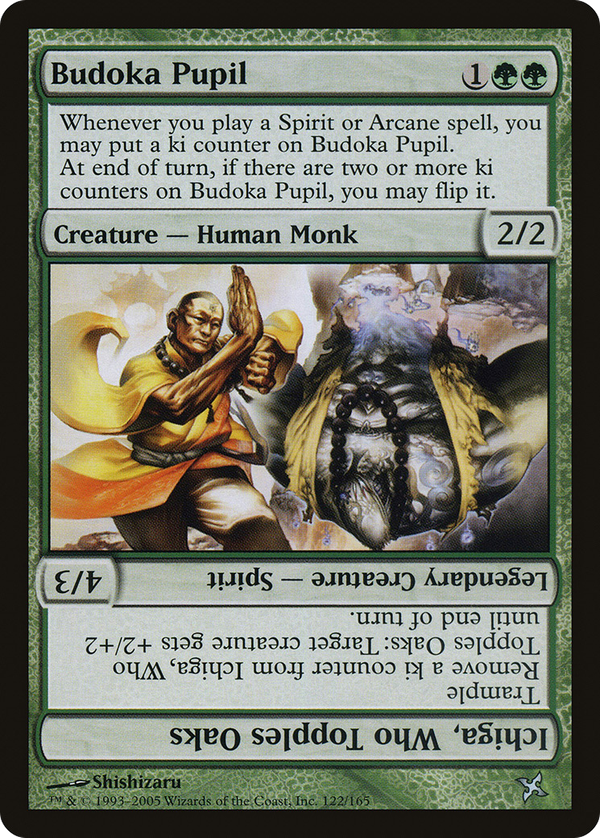
The flip mechanic of this era ran on counters that built up through play rather than payment, and this Monk's carry over to a second use once it transforms. Casting Spirit or Arcane spells loads ki onto the body, and accumulating two or more by the end step transforms it into Ichiga, a Spirit that then spends those same counters back out, each removal granting a creature +2/+2 at instant speed. That is the tension the card resolves: the ki that unlocks the flip becomes the fuel of the result, so a deck wants to keep casting Arcane spells to refill what the pump ability drains. The front half is a 2/2 whose only function is to bank ki and watch for the flip trigger, which makes it slow against any board that punishes durdling: it does nothing to the game until the spell count has done its accumulating. The reward is modular combat reach rather than a fixed bonus, letting one big Spirit hand out repeated tricks across a turn so long as the ki holds. Green's flip cards from this period leaned on the Spirit-Arcane theme to fuel a body that was a placeholder for an engine driven by spell density. The payoff is incremental, the cost is recurring, and the ceiling is whatever you can keep casting: an experiment in making a creature care about a deck's spell count without rewarding storm-style chaining.