Brush with Death


A study in how Buyback misprices the worst kind of effect. The drain itself is trivial: two life each way is the rate you would find on a cantrip-free common, the sort of spell that fills a flavor slot more than a deck. But Buyback, the mechanic built to turn one-shot spells into recurring engines, priced the recursion against the spell's ceiling rather than its floor. Here the floor is so low that no recursion premium makes the loop worthwhile: paying four extra mana to return a four-life swing is the kind of math that only resolves favorably across many turns, and a card asking for that much patience needs a payoff that climbs faster than two life per cast. The design lesson is that Buyback works when the base spell already wants to be cast repeatedly (a bounce, a removal piece, a token-maker) and curdles when it is bolted onto an effect with no inherent reason to recur. This is the latter: a marginal drain wearing the most expensive recursion clause around, where the clause has nothing worth repeating to attach to.
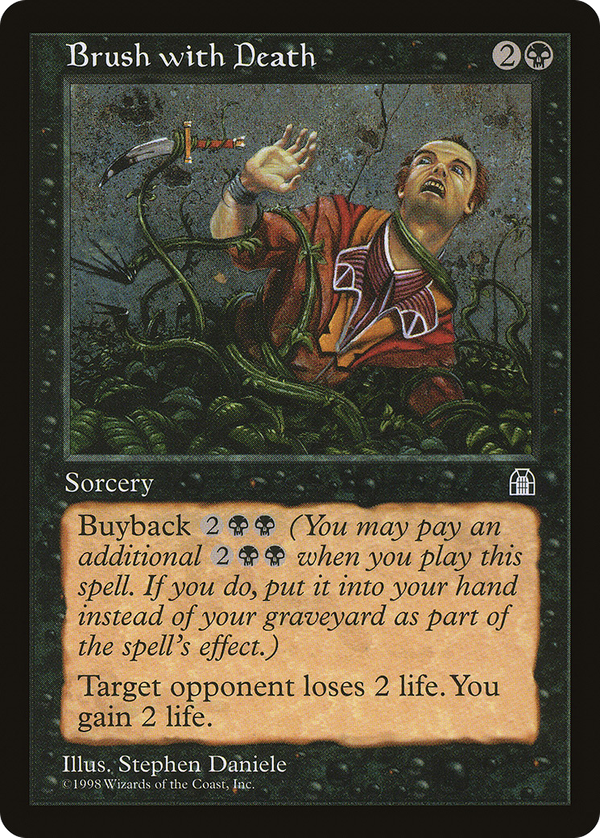
Rules text
(You may pay an additional as you cast this spell. If you do, put this card into your hand as it resolves.)
Target opponent loses 2 life. You gain 2 life.