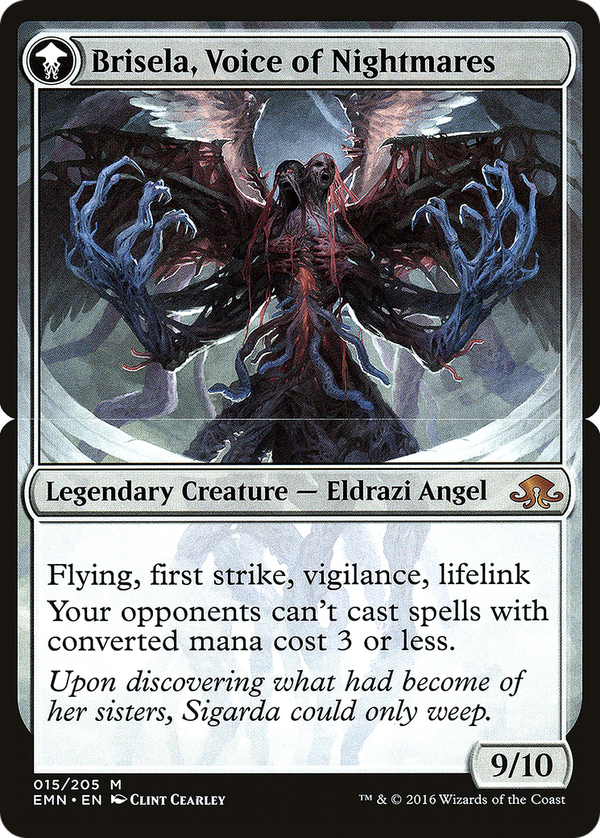
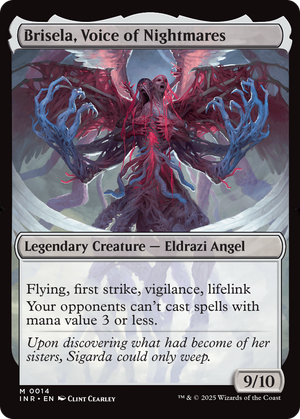
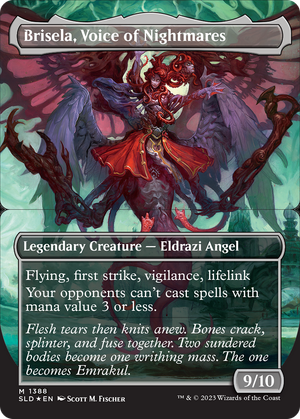
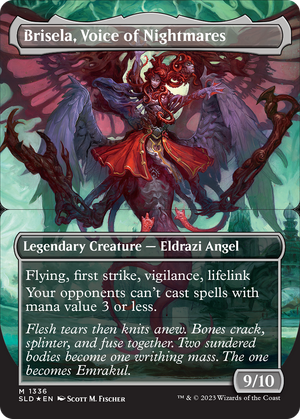
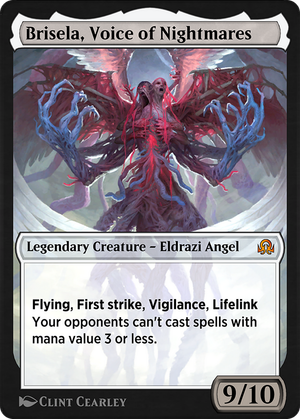
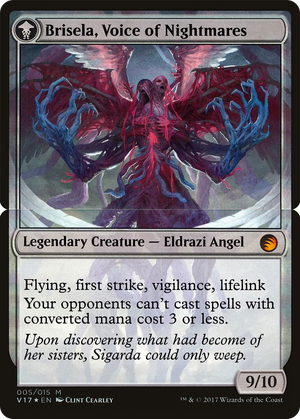
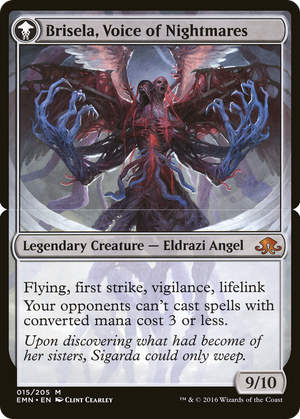
Brisela, Voice of Nightmares
Meld payoffs live or die on whether the assembled creature justifies the tax of running two halves and waiting to fuse them, and this one answers by rewriting the rules of engagement rather than just the board state. The static clause is the whole proposition: opponents simply cannot cast anything with mana value 3 or less, which locks out the cheap interaction that would otherwise unmake a fragile-by-comparison eleven-mana body. Removal at one or two mana, the burn that punishes a tapped-out caster, the cheap counterspell holding the door, all of it goes dead the moment Bruna, the Fading Light and Gisela, the Broken Blade meld. What is left, the four-and-up spells, tends to be slower and easier to see coming, and a 9/10 with first strike, flying, vigilance, and lifelink outraces them before the opponent draws into the answers they are still permitted to play. The lifelink does more work than the keyword pile implies: it widens the cushion against the few high-cost burn or reach effects that survive the lock, so the race math rarely favors the opponent. What separates this from most assembled bodies is that the payoff is a continuous prison, not a one-time swing: the lockout is a static ability, so it holds the instant the two halves combine and never lapses, walling off cheap answers turn after turn. The cost is real (assembling two specific cards is a steep ask), but the reward is a soft prison stapled to a finisher that almost never needs a second hit.