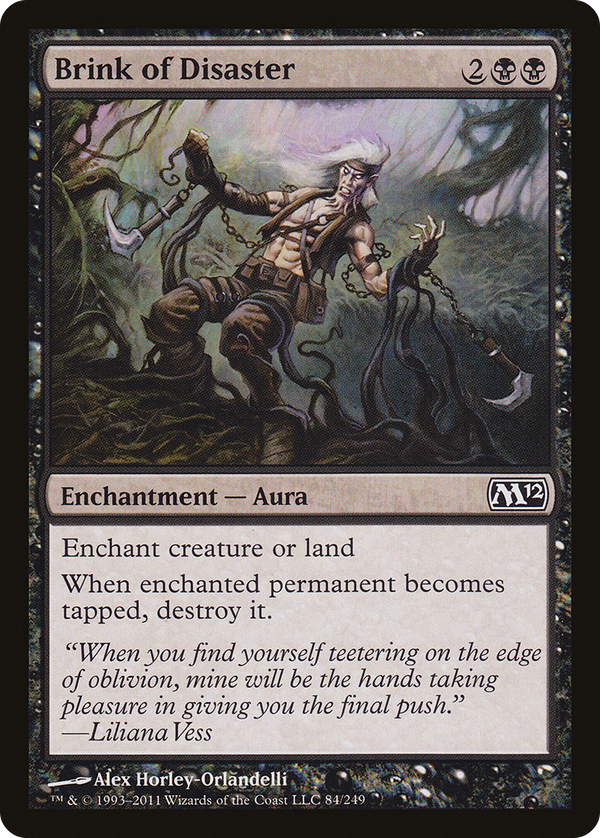
Brink of Disaster


Most black removal hands the destruction to the caster: this hands the trigger to the opponent, and waits. The clause watches for a tap, and nearly everything an opponent wants to do involves tapping: declaring an attacker, paying a tap-cost activation, or turning a land sideways for mana. The land mode is the sharper edge of the design. Enchanting a creature reads as a Pacifism that ends in death instead of stalemate, punishing the act of attacking; pinning the Aura to a land converts a routine resource into a trap, where the opponent either declines that mana or springs the destruction themselves. The price of that flexibility is reactivity. It cannot answer a creature that never needs to tap, cannot touch an enchantment or an already-settled board, and largely surrenders the timing to whatever taps the target. Understood honestly, it is a soft lock wearing removal's clothes: a four-mana commitment that sits inert until the target moves, then trades the permanent for nothing. That conditionality is also why cleaner unconditional black removal has always crowded it out: it swaps a guaranteed answer for a worse rate and a dependency on the opponent's own choices, the kind of trade that looks elegant in the abstract and plays out as a stalemate at the table.