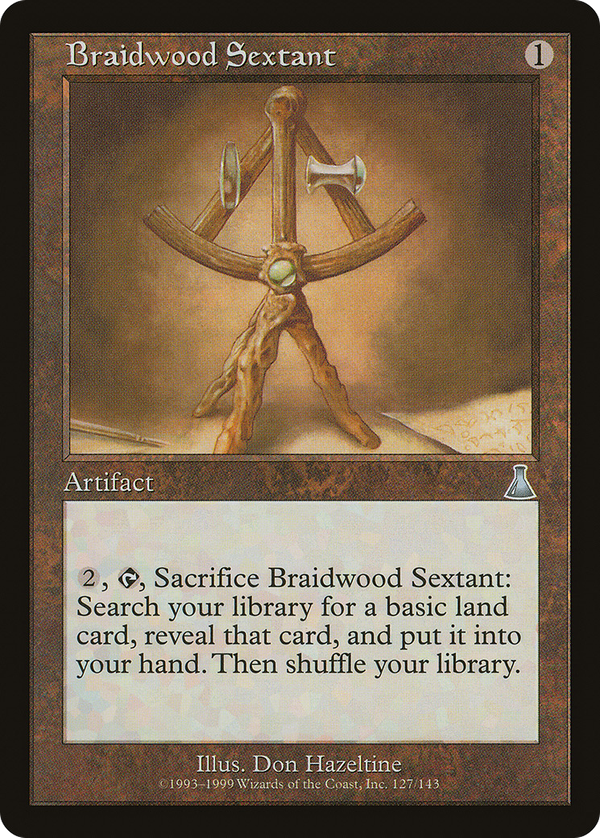
Braidwood Sextant

The flavor pulls its weight: a navigational instrument carved from wood that points you toward land. As a card, it answers the oldest deckbuilding tension in the game (drawing the basic you need, when you need it) by splitting the payment across two moments. You pay one mana up front to bank the option, then spend two more and crack it on the turn a color actually goes missing. That deferred-cost structure sets it apart from land-tutors that demand their whole price at once: cheap deployment lets you commit it early and decide the payoff turn whether you still need fixing or would rather spend the mana elsewhere. Three clauses fence it in at fixing. It finds only basics, sends the card to hand rather than the battlefield, and sacrifices itself in the act, so it never tips into ramp. This is a deliberately slow, deliberately cheap design in the family of artifact land-finders that trade tempo for color certainty. The shuffle at the end is the quiet tax most readers forget: it scrambles any deck arrangement you had set up, which is the real reason it never became a combo enabler rather than what it was built to be, a humble repair for a stranded mana base.
Rules text
 ,
,  , Sacrifice this artifact: Search your library for a basic land card, reveal that card, put it into your hand, then shuffle.