Braidwood Cup

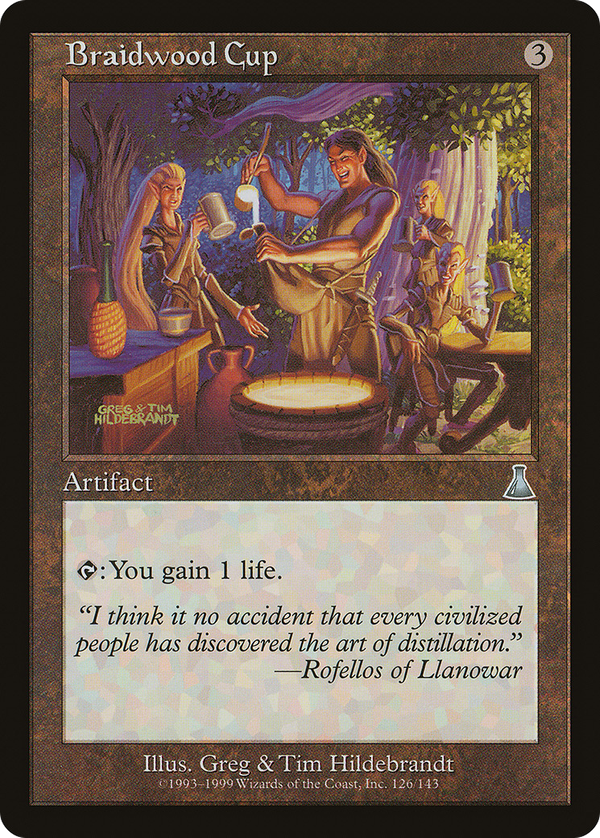
Three mana for an artifact that taps to gain a single point of life is the kind of rate that has no home in any era of competitive play, and that is precisely the point: this belongs to the long tradition of artifacts that exist to be objects more than effects. The lifegain is incidental, a half-step above doing nothing, the sort of ability slapped onto a permanent so it technically reads as a Magic card. What the cup is actually for is the cup. The art is a literal goblet, the name evokes a craftsman's piece, and the card sits in a class of flavor-first artifacts (decorative items, ceremonial objects, treasures with no real treasure inside) that fill out a set's world without ever filling out a deck. Compared to the era's actual lifegain workhorses, the activation cost in time and the negligible payoff make it functionally inert at the table. It is a reminder that not every card in a set is built to be played; some are built to populate the plane, to give the booster a piece of furniture, to be the artifact you read once and never sleeve. The honest read is that the Braidwood Cup is an artifact in the way a museum vitrine holds an artifact: there to be looked at, not used.
Rules text
 : You gain 1 life.