Braids, Cabal Minion


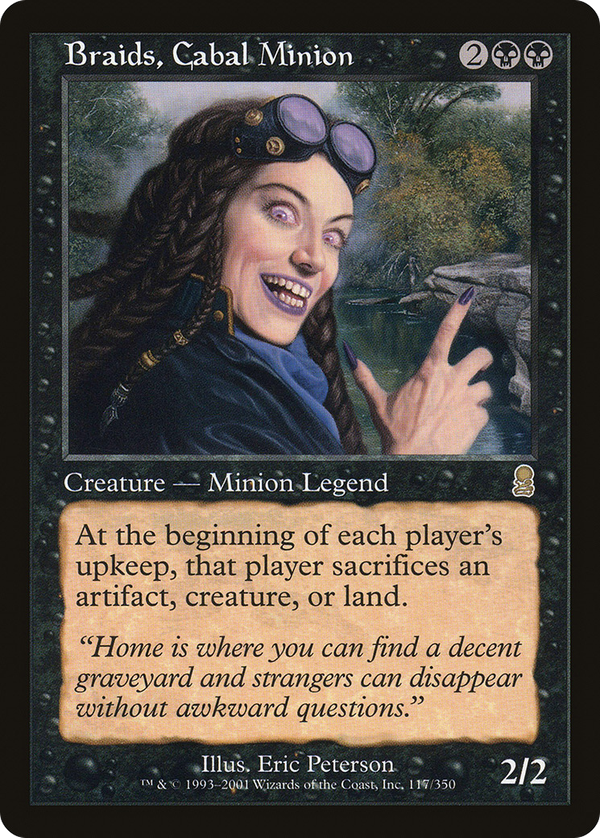
Every player sacrifices an artifact, creature, or land each upkeep, controller included, which reads as a tax that hurts both sides equally. It never does. The forced sacrifice falls on everyone, but the trick is who can afford it: an aggressive or empty-handed deck pays in spare lands while the opponent loses creatures and artifacts they still need on the board. That gap of who-has-stuff-left is the entire engine, and it sits behind a fragile 2/2 that the same upkeep tax does nothing to protect. The card became the namesake of a stax archetype that treated her as a clock, racing her out early and then strip-mining the opponent's board faster than they could rebuild, sometimes alongside effects that let one side dodge the bill. Wizards eventually rebuilt the idea in a more controllable shape with Smokestack, where the sacrifice count ramps and a player chooses what to feed it; the original instead committed to a creature you have to keep alive and a tax that grinds at a flat rate, one permanent per upkeep, forever. Note what the restriction leaves untouched: enchantments and planeswalkers sit safely outside the bill, so the side that loads its board with those permanents pays the tax in lands it never wanted anyway. The evenness was never the point, only the surface the asymmetric deck weaponized.