Bounty Hunter


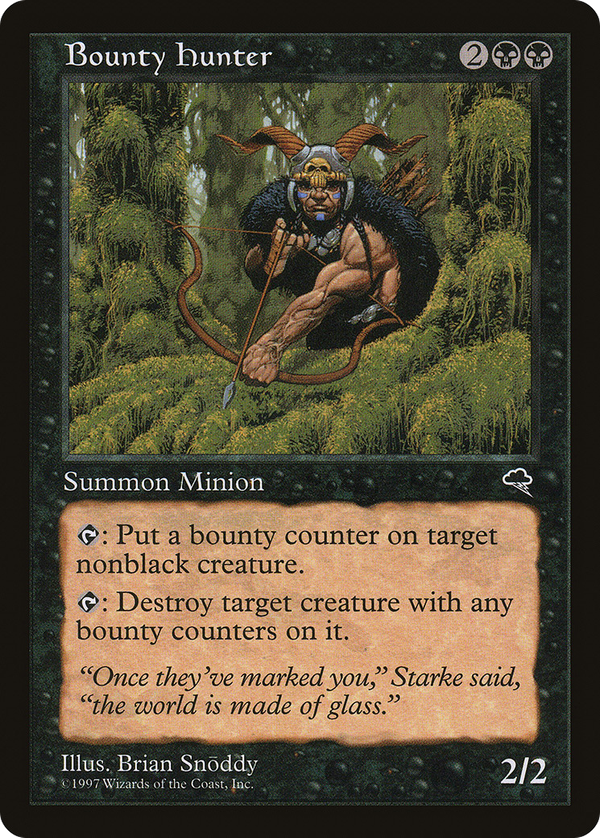
Two separate taps sharing one body: the marking tap and the killing tap are distinct activations, so on its own this 2/2 can land a bounty one turn and cash it the next, killing a creature every other turn rather than every turn. The earliest a freshly cast copy can destroy anything is the turn after the bounty lands; you have to telegraph a target and then survive long enough to follow through. That split across time is the discipline that justifies an open-ended kill clause on a small body: the counter has to go on something already in play, and the two abilities cannot both fire in a turn unless something else untaps it. The nonblack restriction is a target gate, not a deckbuilding one. It does nothing to stop a black deck from running the engine (the card is heavily black itself at ); it simply walls off black creatures from being marked, keeping them safe from this brand of destruction unless something else manages to place a bounty counter on them. Mechanically it sits in the lineage of recurring spot removal stapled to a creature, the space Royal Assassin and Nekrataal occupy from different angles: Royal Assassin needs its target tapped, Nekrataal pays its kill up front and walks away as a body. Bounty Hunter spreads the cost across turns instead, the reason it has always been a grindy attrition piece rather than a tempo play. The counters it leaves behind persist even after the body dies, so a marked creature stays a standing invitation for any future copy to finish the job.
Rules text
 : Put a bounty counter on target nonblack creature.
: Destroy target creature with a bounty counter on it.
: Put a bounty counter on target nonblack creature.
: Destroy target creature with a bounty counter on it.