Boulderbranch Golem

One physical card holds two whole spells, and the enters-the-battlefield trigger is what stitches them together. Cast the 3/3 for a light green splash and gain three life; pay the full seven for the 6/5 and gain six. Because the lifegain scales with whichever power you paid for, neither mode reads as a stripped-down version of the other: the small green creature is a legitimate early blocker with a little padding, and the colorless top-end is a genuine late-game body with a bigger cushion. This is where prototype separates from a surcharge mechanic like kicker: with kicker you buy a bigger version of one card, but here you are choosing which of two cards you drew this turn, at cast time, and each keeps the same abilities and types. The lifegain is deliberately plain (it asks nothing of your graveyard, your board, or your sequencing), which keeps the card an honest floor rather than the front half of an engine. That restraint is the point. A card built to fill dead early turns on a seven-drop cannot also be a reward for building around it, or the small mode stops being a real choice and becomes a consolation. What you get instead is a decision with no wrong answer, only a timing question: cheap defense with a small buffer now, or a finisher with a larger one later.
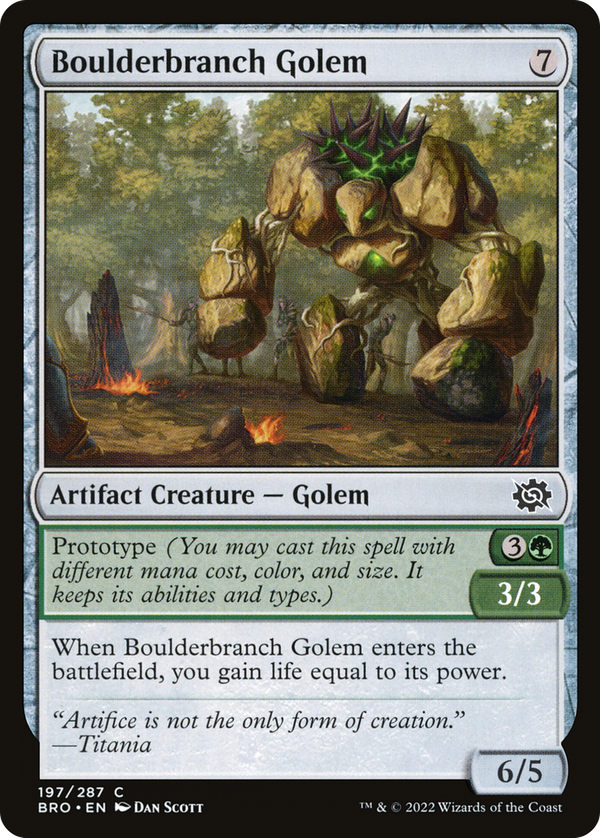
Rules text

 — 3/3 (You may cast this spell with different mana cost, color, and size. It keeps its abilities and types.)
When this creature enters, you gain life equal to its power.
— 3/3 (You may cast this spell with different mana cost, color, and size. It keeps its abilities and types.)
When this creature enters, you gain life equal to its power.