Boros Cluestone

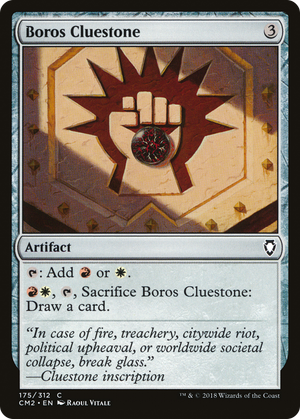
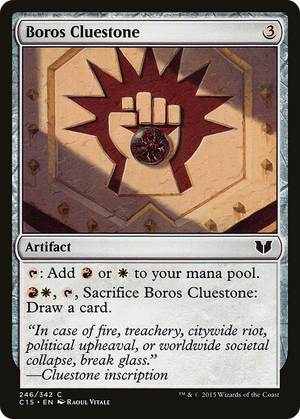
The Cluestone cycle is built around a sacrifice clause that doubles as an apology for the floor. A three-mana rock that taps for only red or white is a weak rate once early acceleration stops mattering, so the design hands the card its own off-ramp: pay 
 , tap it, and crack it for a fresh draw rather than leaving a do-nothing artifact parked on the board. That conversion carries no timing restriction, so it can fire at instant speed in response to a board wipe or on an end step, and it consumes the rock in the process, which is what keeps the line honest. This is insurance against flooding on mana rocks, not a repeatable engine; each one trades exactly itself for exactly one card. Set against rocks that filter colors or that can turn sideways as a creature, the Cluestones do the most modest job a dual-color rock can do, then refund themselves before they become a liability. The design asks nothing of the deck around it and rewards nothing in particular: it smooths the opening turns, and when that stops being useful it leaves the battlefield as a cantrip instead of dead weight. The whole thing is aimed at the late-game problem every multicolor ramp shell eventually hits, where the rocks that smoothed the early game become topdecks you regret. This one simply refuses to be one.
Rules text
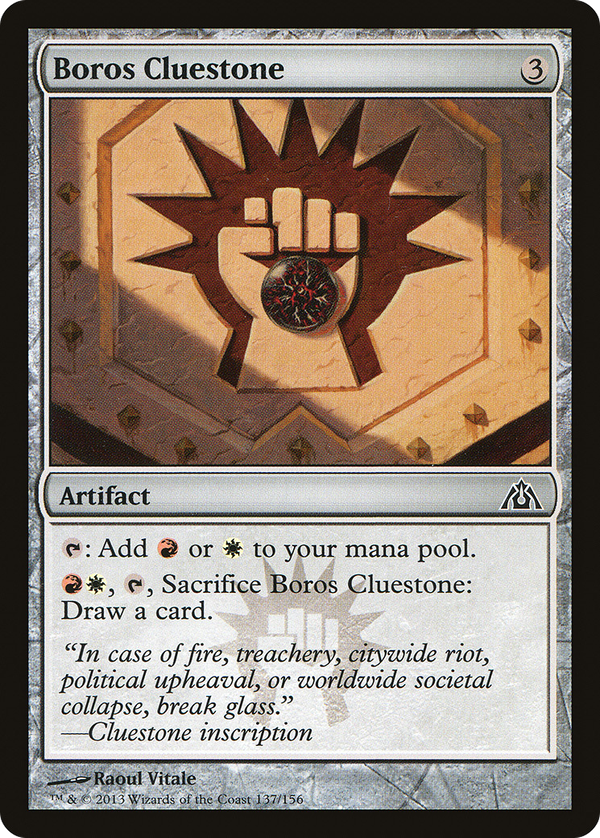
 : Add or .
, , Sacrifice this artifact: Draw a card.
: Add or .
, , Sacrifice this artifact: Draw a card.