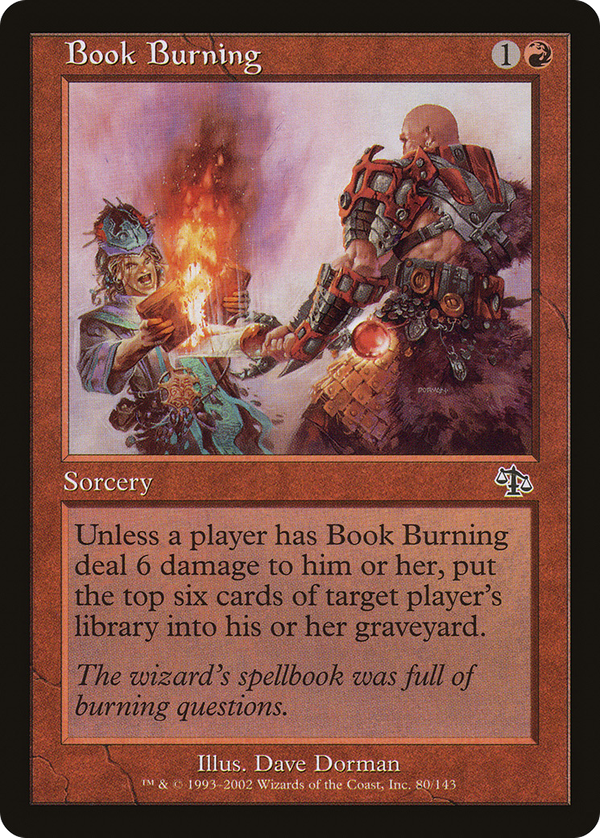
Book Burning


The mill is the headline; the choice is the card. What it actually does is put a decision in front of the entire table: any player may volunteer to take six damage, and only if nobody does will the targeted player lose six cards off the top. That single clause turns a two-mana sorcery into a negotiation, because the effect that resolves is never yours to dictate. The price of refusing the mill scales with the board: early, when six life is a comfortable cushion, almost anyone can step in to spare a stocked library; late, when six damage reads as a death sentence, the mill resolves because no one can afford to absorb it. It descends from a strain of symmetrical, table-facing red design where a spell is worth whatever the group collectively decides it cannot prevent. The damage is something a player chooses to take, not life you make them pay, and what gets protected by taking it is the targeted library, not anyone's graveyard. So the spell shifts axis with the life totals around it: against a player who can no longer survive the burn, it functions as a six-card mill nobody will block; against a healthy table guarding a thin library, the redirected damage is cheap and the mill rarely lands. Two outcomes, one shell, and the deciding vote can belong to anyone at the table, the caster included.