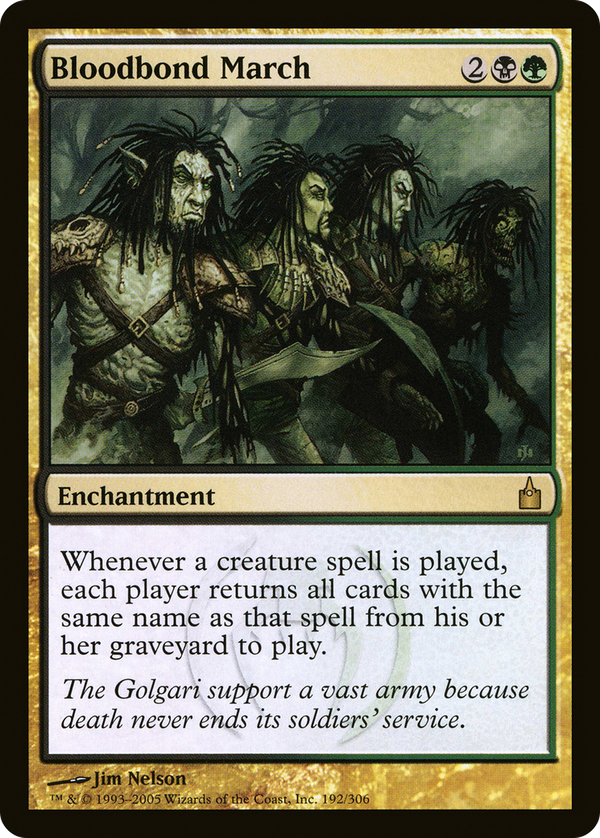
Bloodbond March



Symmetry built around a clause most cards never touch: names. Every creature spell anyone casts returns every card with that name from every graveyard, and the trigger fires for both players regardless of who cast it. That makes this a political engine more than a value engine. The math only tips in your favor if your graveyard is stocked and theirs is not, or if the creature being cast happens to match a card only you have in the bin. Because the returned cards enter under their owners' control, you cannot simply reanimate an opponent's threats; you can only flood the board on parallel tracks and trust your half is better. The design wants duplicates: a deck running multiples of a single creature can cast one copy and resurrect the rest in a single mass return, which is where the card stops being a curiosity and starts being a loop. Pair it with a creature you can recast cheaply and a sacrifice outlet, and the name-matching turns into an arbitrarily large recursion chain that drags everyone else's identically-named dead creatures along whether they want them or not. It is a four-mana enchantment that idles harmlessly until the table forgets it is there, then resolves into a board state the architect designed and everyone else stumbled into: an open invitation that punishes anyone keeping mirrored cards in the yard and rewards the one player who planned around it.