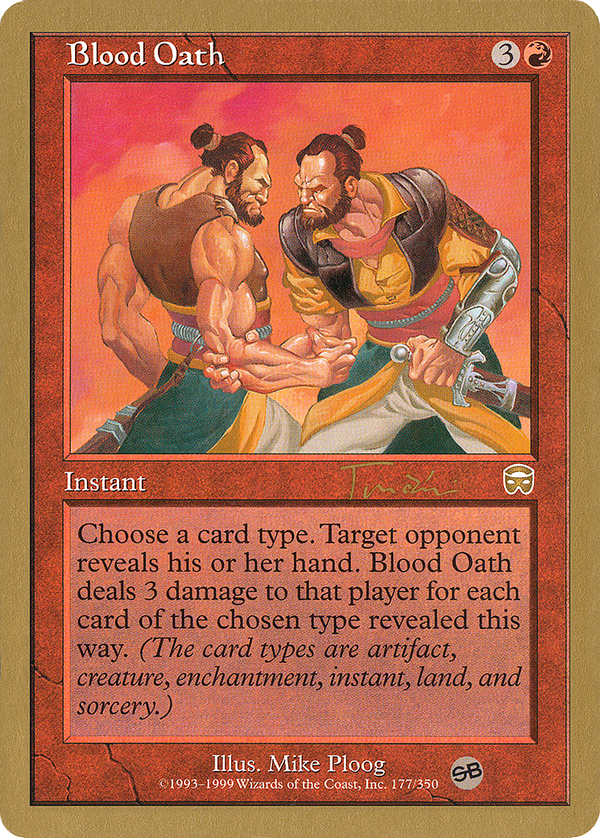
Blood Oath


The damage is set by your opponent's deck, not by your own mana, and that single inversion is the design's whole gamble. Name creature against a hand stuffed with threats and the payoff is enormous; name land and you might whiff for zero, or catch a flooded grip for nine. Most direct-damage spells of this era priced their output at a fixed rate per mana, with the only variable being where the bolt landed; this one untethers the number entirely and ties it to a prediction about a hand you cannot see. The reveal clause is the consolation: even a wrong guess hands you complete information about what your opponent is holding, so the floor is never quite a total blank, just a card that scouts instead of burns. Instant speed turns the read into a timing question too. Fire it in response to a draw step or a tutor resolving and you sharpen the odds, naming the type you expect to be most concentrated at the moment it is most concentrated. The result plays less like burn than a poker call, swinging from inert to lethal on one naming decision, and it can only ever hit a player's face, never their board. The skill it asks for is not sequencing or rate evaluation but reading an opponent, a strange thing to demand of a four-mana instant and exactly why it has remained a curiosity rather than a fixture.