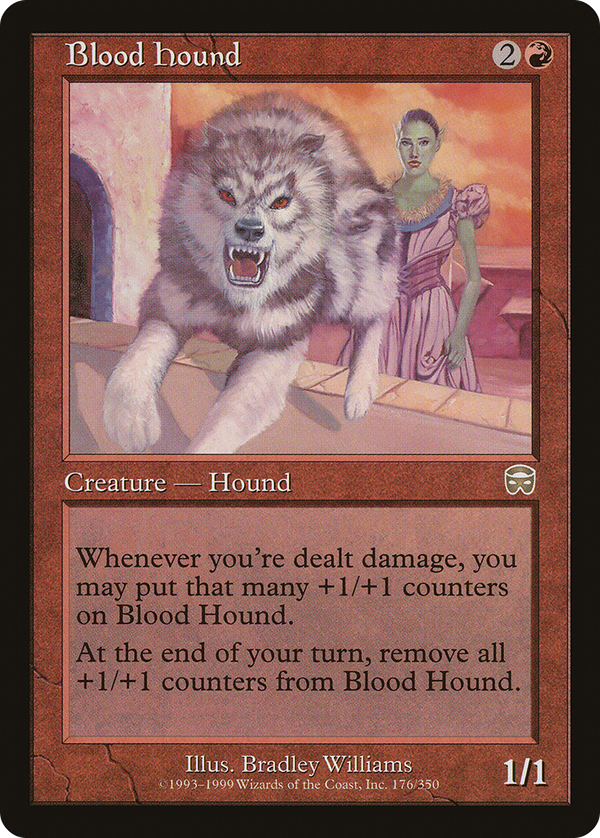
Blood Hound


The reward structure here runs exactly backward from how a creature usually wants to grow. Most counter-based bodies scale on your own initiative: you attack, you sacrifice, you pay mana to pump. This one only swells when you, the controller, take damage, and then dumps every counter at your end step, so the growth is borrowed against your turn, not banked across turns. The design converts incoming damage into a temporary blocker or a one-turn attacker, which makes it a deterrent more than a threat: a creature that gets bigger precisely because you are losing the life total it is supposed to be protecting. The catch buried in the timing is that "you" means the controller, not the creature, so any source that hits you (combat, burn, even your own pinging) feeds it, but the window slams shut at end of turn. It is a fragile 1/1 that grows only in the moments you would rather not be in, an inversion that points its lever at the opponent's offense instead of its own controller's plan. Early-era design was full of these contrarian small-creature experiments, mechanics keyed to actions you spend the rest of your deck trying to prevent, and most of them never found a home for exactly that reason: the trigger condition is the thing you are working hardest to avoid.