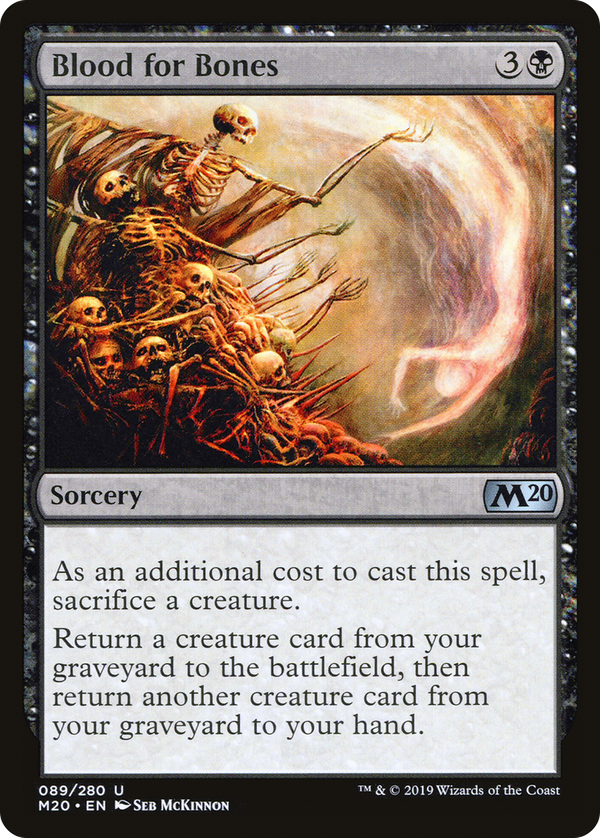
Blood for Bones


The sacrifice is the payment, not the price. Because the creature you kill pays an additional cost, it hits the graveyard before the spell resolves, and since nothing here is chosen until resolution, that body is fully eligible for the returns it just fueled. That sequencing is the whole trick: bring a single creature card to the cast, sacrifice a second one to pay the cost, and both halves still have something to work with, because the freshly dead creature can fill in as the second creature chosen on resolution. You spend a body whose enter-the-battlefield effect or death trigger has already cashed out, drag a bomb back onto the battlefield, and pull a second creature to hand to keep the loop primed. The split return (one to the battlefield, one to hand) is what makes it more than straight reanimation: it advances the board and reloads at the same time, so one cast sets up the next. The cleanest partner is a creature whose entering matters more than its staying, since it earns twice over: once as sacrifice fuel, once when it returns to fire its trigger again. The cost is that the effect stalls out on a truly empty graveyard, so the shell around it has to treat the yard as a working resource rather than a dumping ground. It is a workhorse for sacrifice-and-recur builds that regard creatures as expendable material, not permanents to protect.