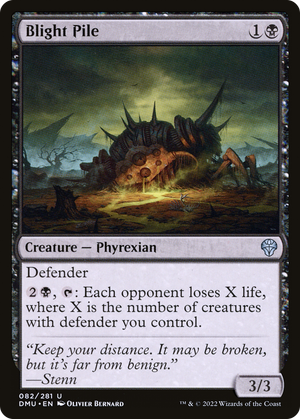
Blight Pile


Defender walls are normally a defensive tax: bodies that trade downward, hold a line, and do nothing to close a game. This one inverts the deal by turning the wall count itself into a clock. Every creature with defender you control becomes a point of drain per activation, so the stall you build to survive is the same board that ends the game. The reward scales with the exact stat that usually signals a losing, passive posture: how many things you have that cannot attack. That inversion is why the card was drawn the way it was. A 3/3 for two mana that can never swing is a poor rate, and the activation is expensive enough that a lone copy is barely a threat. The card is written to assume company, a spread of Walls and other stationary bodies feeding a repeatable, opponent-agnostic life-loss engine that ignores blockers and combat math entirely. It hits each opponent, so the payoff grows with the table rather than shrinking against multiple foes. What it asks for is a deck that treats defenders as a resource to accumulate rather than a stopgap to deploy, which is a narrower ask than most two-drops make; the body alone earns nothing, and the engine only turns over once the wall count climbs.
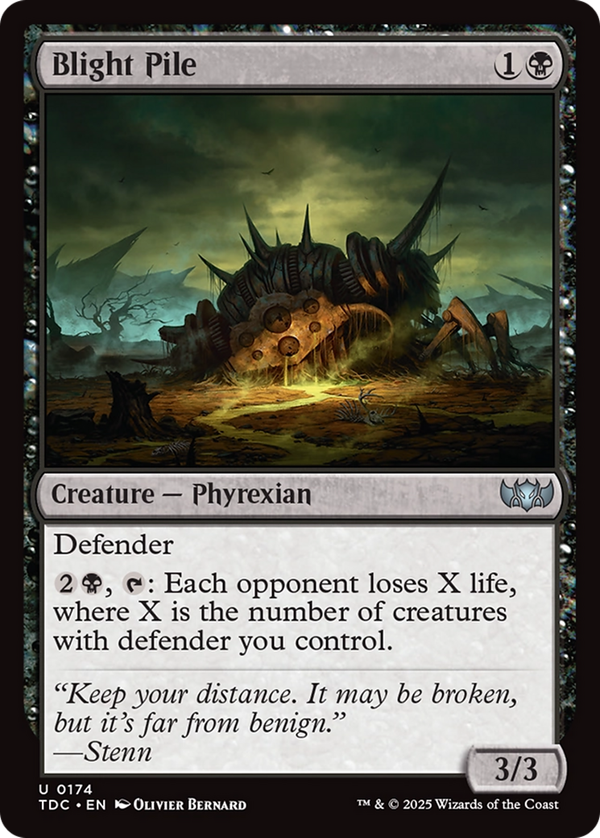
Rules text
 ,
,  : Each opponent loses X life, where X is the number of creatures with defender you control.