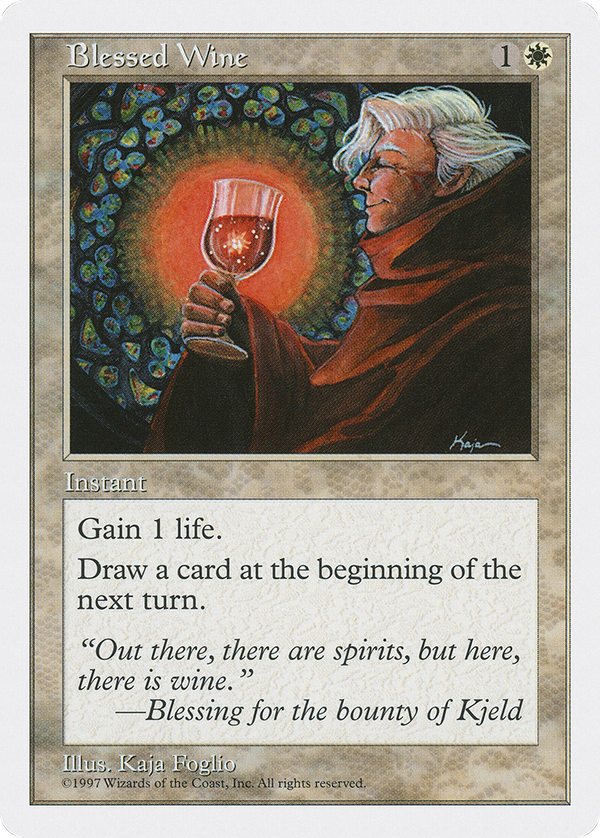
Blessed Wine


A two-mana cantrip with a deliberate hitch: the life gain happens now, but the card does not. By deferring the draw to the next turn's upkeep, the design puts the actual replacement out of immediate reach, and that delay is the whole balancing mechanism. The instant timing salvages it, and it is more pointed than it looks: held until an opponent's end step, you spend the mana when nothing better is on offer and collect the card on your own upkeep, a wait of only half a turn rather than a full one. Resolve it during your own turn and the card instead arrives on their upkeep, where anything can interfere before it gets to you. This belongs to an early-game school of card-advantage design that treated drawing a card as a luxury to be parceled out with strings attached, before the template settled on the immediate, no-strings cantrip as the default. The rate is modest by later standards (the single point of life gain is filler, not the load-bearing part), and the friction it asks you to absorb is the deferral itself: the card that smooths your draw is one you cannot touch this turn. The result is built around patience rather than power, where the only real question is whether the timing window is worth the wait.