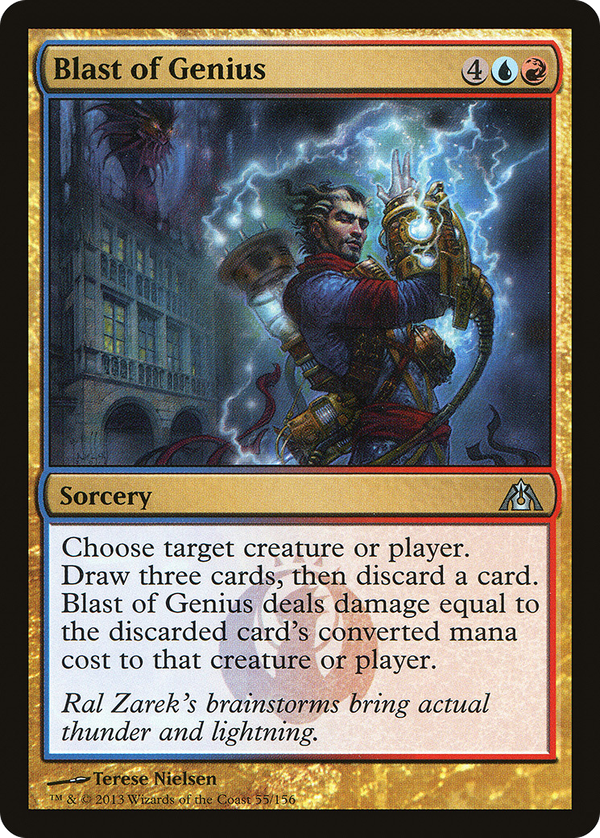
Blast of Genius



The whole design hinges on one self-defeating tension: the card you most want to throw is the one you least want to lose. Drawing three and discarding one is the engine, and the discarded card's mana value sets the damage, so the punchline scales with the size of the card you're willing to pitch. That builds a real decision into the spell rather than a fixed number. Pitch a stranded fatty you couldn't cast for a haymaker; pitch a land and the discarded card's mana value is zero, so you've banked the dig and dealt nothing; or, in the rare gap, draw into exactly the bomb you wanted and now have to weigh keeping it against the burn it would deal. It can hit a permanent or a player, so the same spell answers a threat or closes a game depending on what the top of your library hands you. The cost is the honest tax on all of this: six mana for a card-advantage spell whose damage you don't fully control until you've drawn is a steep ask, and the variance cuts both ways. Draw three cheap spells and lands and your "blast" sputters while you've spent the turn. That randomness is the point and the problem at once, which is why the design has always read as a fun engine more than an efficient one: a Gruul-by-way-of-Izzet idea about turning excess cards into face damage, priced so the payoff never quite outruns the gamble.