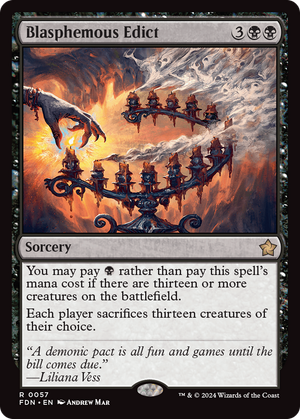
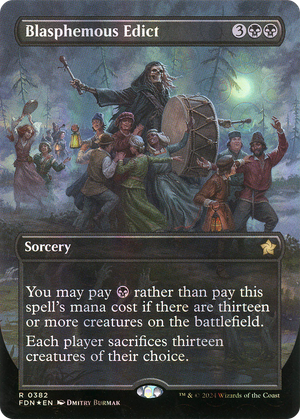
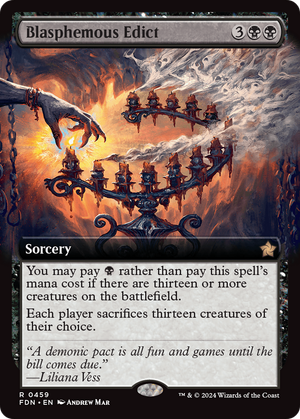
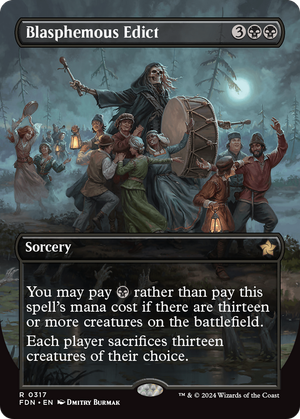
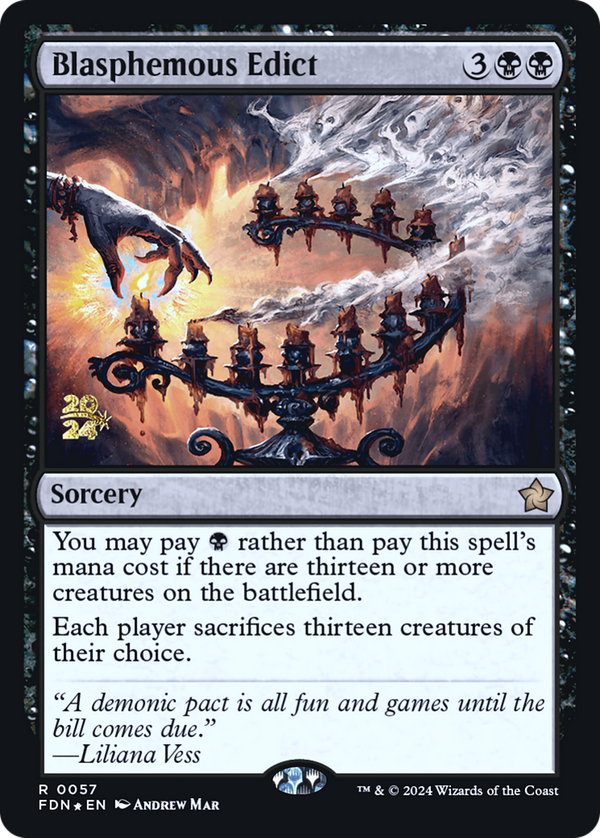
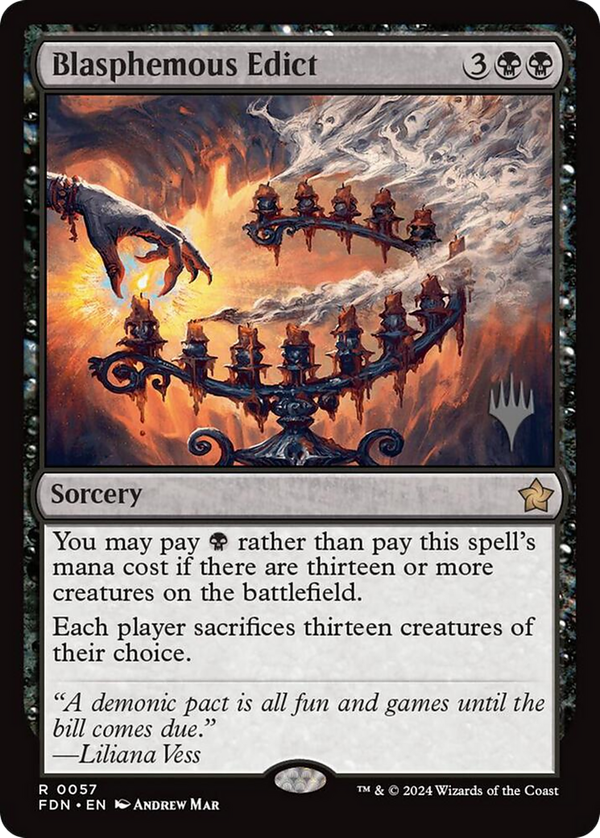
Blasphemous Edict


The number thirteen is doing every bit of the work here, and the design is a joke told in three parts. Sacrificing thirteen creatures at once is already a board-scouring effect that only lands when tables have overcommitted; the alternative cost that lets you pay a single black mana instead, but only when thirteen or more creatures are already on the battlefield, turns a five-mana sorcery into a one-mana reset the moment the board is fat enough to justify it. That conditional is the balancing act: the discount arrives exactly when the wipe matters most, and never when you want to point it at a small board. The each-player clause keeps it symmetrical, so the trick is engineering a lopsided aftermath: leave behind tokens you can spare, or reach thirteen through a wide go-wide plan the opponents helped build. It is a wrath that scales with the size of the problem rather than a fixed answer to any board, which is a different structural promise than the flat sweepers black usually gets. The lucky-number gimmick reads as flavor, but it is really a gating mechanism disguised as a punchline: the number has to be high enough that the cheap mode almost never triggers in fair games and almost always triggers in the games that have spiraled out of control.
Rules text
rather than pay this spell's mana cost if there are thirteen or more creatures on the battlefield.
Each player sacrifices thirteen creatures of their choice.