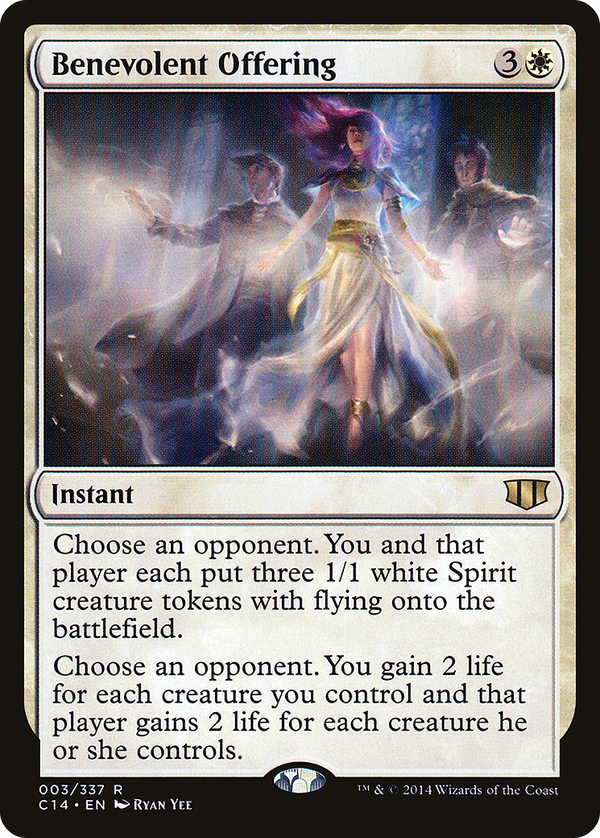
Benevolent Offering


Symmetry is the whole conceit here, and it is symmetry built for one table dynamic in particular: the multiplayer politics deal. Both instructions explicitly hand a chosen opponent the same thing you take (three flying Spirit tokens, then a life payout scaled to board size), which makes the card less a play than a transaction. You are buying goodwill, a temporary alliance, or simply enough flying blockers to survive a swing while a third player gets the same and stays off your back. The two effects resolve in sequence rather than as a choice, and the life gain is where the deal gains its teeth: each side gains independently for its own board, so the player fielding more creatures walks away with more life. That asymmetric payout is a deliberate refusal to make the exchange perfectly even, and it turns the second half into leverage rather than a courtesy. This is a design that only functions where the social contract is part of the game, which is to say a free-for-all rather than a duel. In heads-up play it is close to nonsensical: a four-mana instant that builds your opponent's flock and pads their life total alongside your own. That narrowness is the point, not a flaw. It belongs to a small family of group-game cards whose value is denominated in table relationships rather than raw tempo or card advantage, and it asks you to read the room before you cast it.