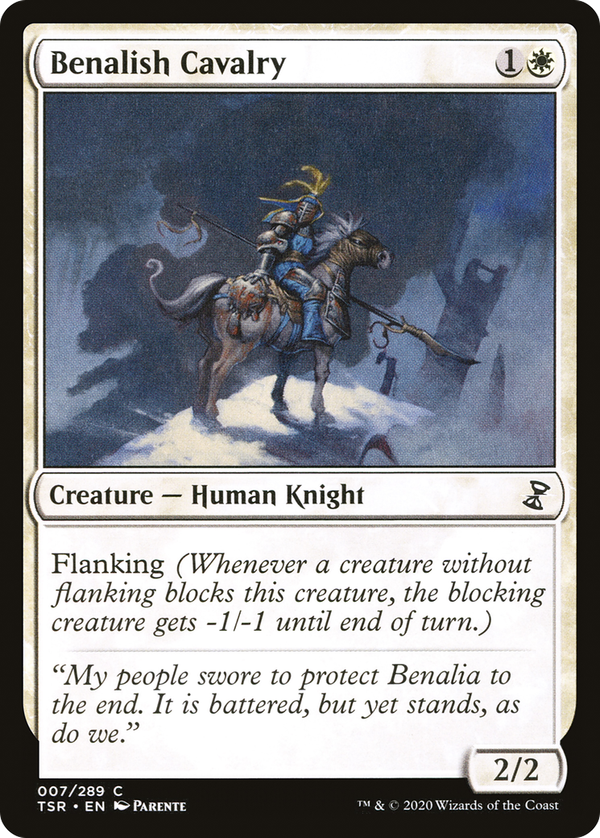
Benalish Cavalry


Flanking exists to give a knight the edge in a fight it would otherwise lose, and this is the cleanest expression of the keyword: a 2/2 with no text beyond the trigger that punishes the block. The combat arithmetic carries the entire card. A ground creature without flanking that walks into this in combat shrinks to a 1/1 before damage, so it loses the exchange even at parity, and the toughness loss can outright kill any X/1 brave enough to block. The keyword was an attempt to reward the attacker structurally rather than through a one-time combat trick: the penalty fires every time an unflanked creature blocks, so the threat is persistent, not a card you spend. It is also a deliberately asymmetric mechanic; another flanking creature ignores the effect entirely, which turned flanking-on-flanking knight matchups into a small design subgame of their own. As a model of combat design, flanking reads closer to a tax levied on every blocker that lacks it than an upside printed on the card itself, and that framing is why a creature this plain plays more aggressively than its body suggests: the opponent's defenders are simply worth less when they line up against it. The cavalry never asked to be more than what it is, a quietly efficient white two-drop that punishes the defender for doing its job.