Belbe's Portal

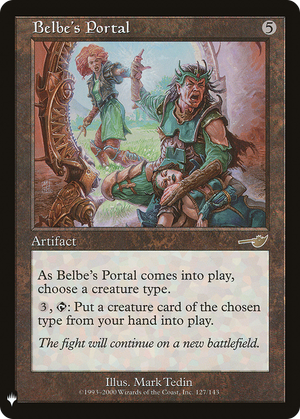
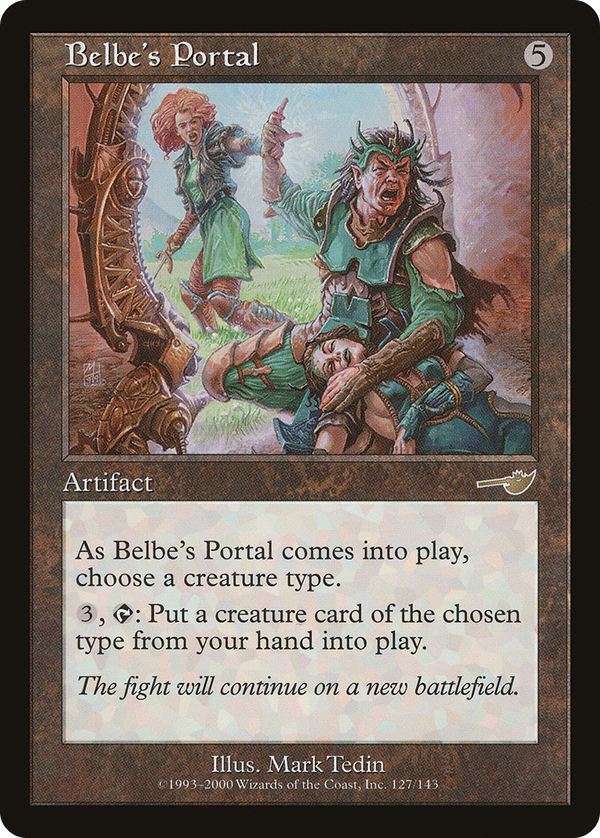
Three generic mana and a tap drops any creature of the named type from hand straight onto the battlefield, which means two things go out the window at once: the cost printed on that Dragon or Angel stops mattering, and the timing restriction on casting it disappears entirely. The second half is the part that earned this a slot in the heavy tribal decks of its era. A portal pointing at an expensive creature type becomes a flash engine, holding open the option to ambush a swing while the opponent's mana is committed elsewhere, and sidestepping the sorcery-speed window where removal would have caught the fatty on its way down. The chosen-type clause is what balances the repeatability. You commit on entry, so the rock only pays off in a deck dense enough in one creature type to justify five mana that leans on a costly follow-up. The lineage runs through tribal payoffs that reward narrowing: pick a lane, then cheat that lane's cost over and over. It belongs to the same late-era push that tried to make creature-type-matters a constructed axis rather than a draft curiosity. What dates it is the up-front five and the three-per-use tax; what keeps it remembered is that it was a cost-cheating tribal anvil before that template became routine, and it still does the one job it was built for, repeatedly, with no off switch.
Rules text
 ,
,  : You may put a creature card of the chosen type from your hand onto the battlefield.