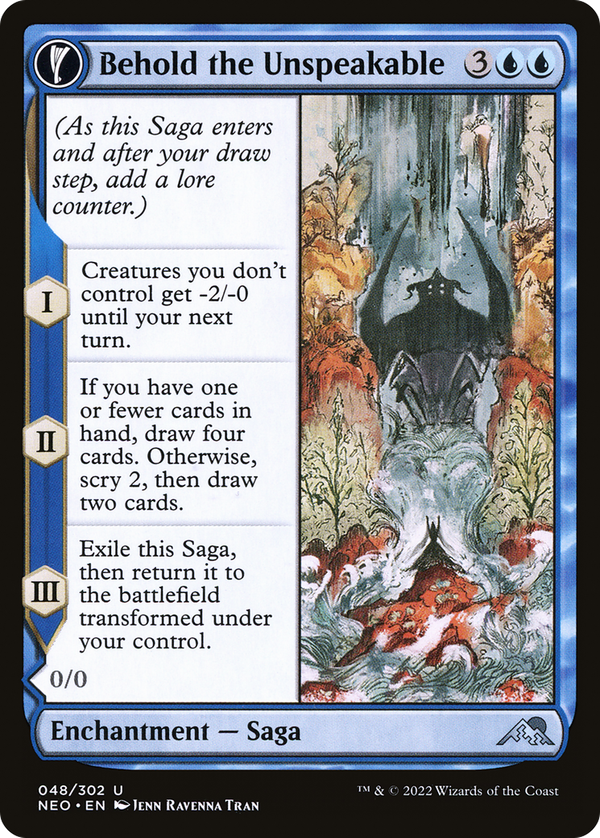
Behold the Unspeakable // Vision of the Unspeakable
The tension the front half resolves is the classic control problem: card advantage that costs tempo. Each chapter buys a turn while it refills, and the sequencing is deliberate. Chapter one softens the board with a defensive shrink to buy the caster time. Chapter two is the payoff, and it rewards playing to the wall of your resources: dump your hand and you draw four, hoard and you settle for a scry-two plus two. Then chapter three flips the whole thing over into a threat, which is where the design gets clever about its own drawback. A saga that draws you a fistful of cards leaves you holding exactly the fuel that makes the transformed Spirit large: a flier with trample whose size scales to a hand you were just paid to fill. The two halves are wired to feed each other. You empty your hand in chapter two, refill it, and by the time the Spirit lands you are holding the cards that make it a clock rather than a chump. It is a control finisher and a card engine folded into the same object, with the flip timing arranged so the front half stops being useful right as the back half starts caring about everything the front half gave you.