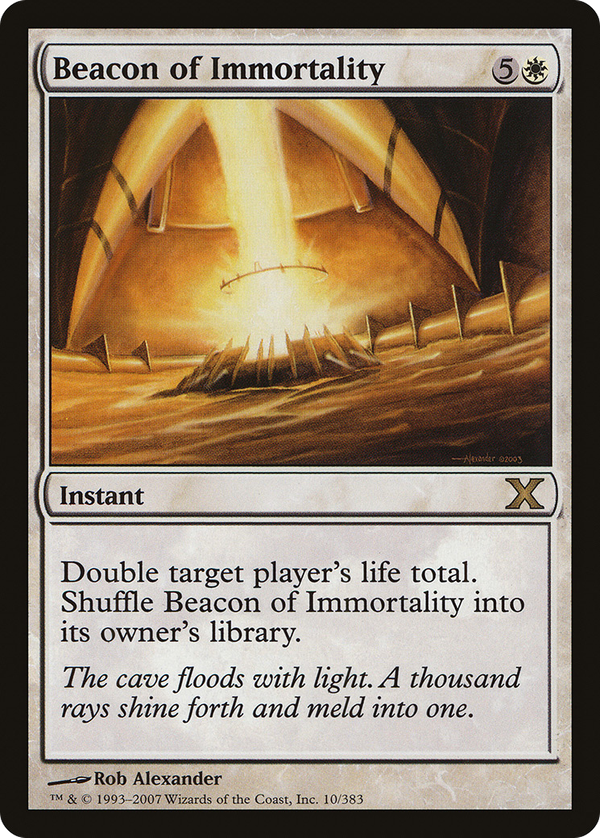
Beacon of Immortality


Doubling a life total scales with whatever has already happened to it: at twenty it gains you twenty, at fifty it gains you fifty, so the effect rewards dedicated lifegain shells that have already padded the number well past its starting value. The genuinely sharp use runs in the opposite direction. Because the doubling can target any player, pairing it with a lifegain-reversal piece such as Tainted Remedy or False Cure flips the math against the victim: the gain equals exactly their current total, and the reversal converts that into an equal amount of life loss, draining them to zero in one stroke. That two-card interaction moved the spell from slow incidental into a finisher once those reversal effects found a home in singleton formats. Shuffling itself back into the deck is the recurring cost: the spell folds away instead of being spent, so it is never quite gone and never quite a reliable draw. The whole Beacon cycle works this way, trading one-shot finality for slow repeatability: each cast reloads itself, but you wait on the next draw to use it again. As an instant, six mana buys the option to hold it up and undo an opponent's lethal swing at the last possible window, or to fuel a life-conversion kill on your own turn; the price is steep enough that the standing question is whether you would rather spend that mana on something cheaper.