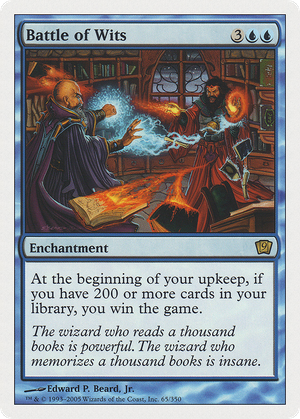
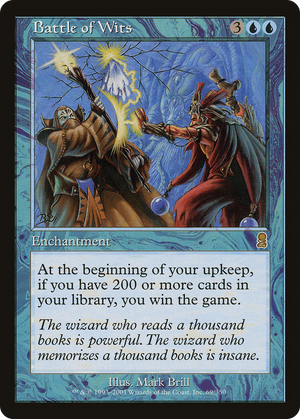
Battle of Wits


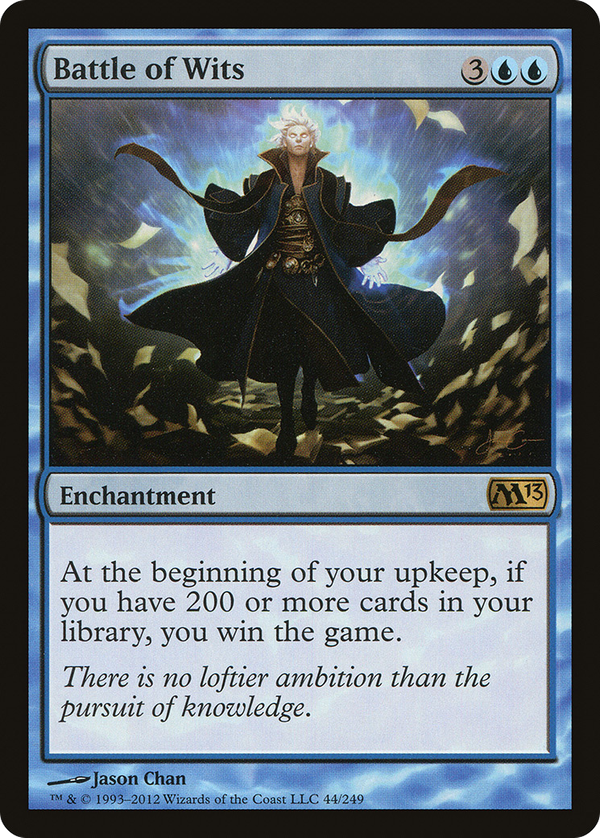
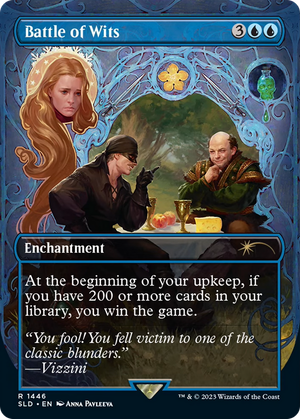
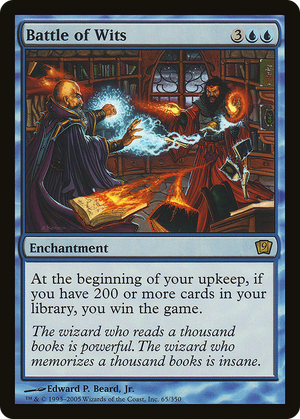
Most win conditions are the payoff for a strategy; this one inverts the relationship and makes the deckbuilding restriction itself the entire game. The number 200 is not a threshold you climb to over the course of a match: it is a constraint baked into your construction, the minimum-deck-size floor pushed well past the standard sixty (typically to around 240 or 250), so the count of how big your library still is when the upkeep trigger checks it becomes the whole proposition. The win does not come from the enchantment resolving; it comes from its triggered ability, which fires at the start of your upkeep and only does anything if the count holds. The result is one of design's purest dares: an alternate win that costs almost nothing in mana relative to its absurdity but everything in consistency. A normal deck is a tuned instrument; a deck built around this enchantment is a haystack you have intentionally salted with a single needle, then asked to draw that needle on schedule. The whole identity lives in that paradox: to win, you must assemble a library so large that finding the enchantment becomes its own subgame, which is why the archetype leans on every tutor, every deep-dig draw spell, every cheap fixing piece that can keep a two-hundred-card pile functional. It belongs to an era fascinated by the library as a raw resource, and it is the most literal expression of that fascination: a card that treats deck size not as a cost to minimize but as the only resource it counts.