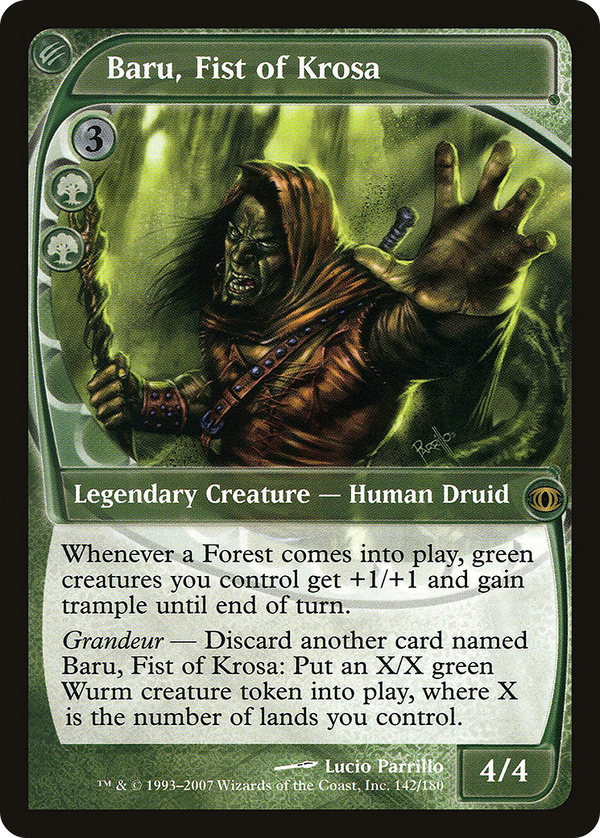
Baru, Fist of Krosa


Grandeur was an experiment in turning the singleton-friendly nature of legendary cards against itself: a payoff that costs you a second copy of the same card, rewarding decks that ran a full playset of a card most people slotted as a one-of. The fantasy here is a green ramp shell that floods the board with Forests, then cashes a redundant Baru into a Wurm whose size scales off every land you control. The body alone is a respectable anthem engine, pumping your green creatures and granting trample each time a Forest hits the battlefield, which is a quiet reward for fetchlands, ramp spells, and any deck willing to skew its manabase heavily toward basics. But the Grandeur clause is the part that defines the card's strategic axis: it asks you to commit to the legend twice, accepting the awkwardness of drawing duplicates of a five-mana creature in exchange for a token that grows larger the longer the game goes. Most Grandeur designs from this era leaned on the same bargain, and most of them shared the same fate of looking better on paper than in a deck that could not afford the redundancy. Baru reads as the green entry in that cycle: an anthem with an alternate use for redundant copies built into its own discard cost, asking a Forest-heavy board to do two jobs at once.