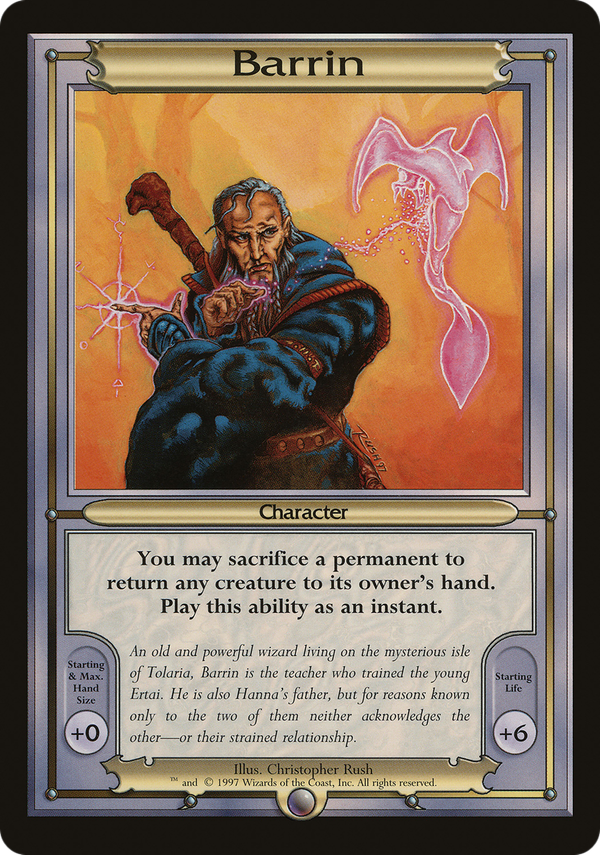
Barrin
The bounce engine attaches to the player, not to anything on the board, and that placement is the entire point of the Weatherlight-era avatars: you chose a persona to "become" for the match, an identity that sat outside your library while granting an activated ability you could fire from your seat for the entire game. Barrin's contribution is repeatable creature bounce, but the cost is the design's center of gravity. Sacrificing one of your own permanents each time means this is grind, not free tempo: you trade board presence for the reset, and the math sours fast against a developing opponent. Because the source is the avatar rather than a card in play, nothing your opponent does can counter it, destroy it, or target it; the engine persists no matter what happens to the table, which is exactly what made the format tick. Vanguard never broke out of its casual organized-play niche, and the avatars now live mostly as curios and cube novelties rather than competitive objects. As design history, though, Barrin is instructive: Wizards was prototyping a player-attached engine, an activated ability sourced from outside the deck and immune to the usual answers, years before emblems and companions formalized the idea of game-state effects originating from beyond the deck and graveyard.