Ballroom
A dual land that comes in tapped is a familiar shape; grafting a card-drawing sink onto the back end is what makes this one worth a slot rather than just a fixing choice. Once the manabase is settled and the top of the curve is empty, that four-mana activation converts an otherwise idle land drop into a Clue, and eventually into a card. This is the same design logic behind creature-lands and lands that filter or cycle: give the color-fixing role a late-game function so the card never becomes a dead draw in the second half of a game. Investigate is the specific mechanism here, which layers in a second delay: the Clue itself costs mana to crack, so the full loop from land to card runs through two payments and a sacrifice. That deliberate friction is what keeps the ability from being free card advantage stapled to a nonbasic that simply taps for two colors; you pay for the flood insurance twice, and only when nothing better is competing for the mana. The white-black pairing fits the effect cleanly, since those are the colors most likely to be grinding toward attrition rather than racing, and a land that quietly buries excess lands under a card is exactly the kind of long-game equity such decks want.
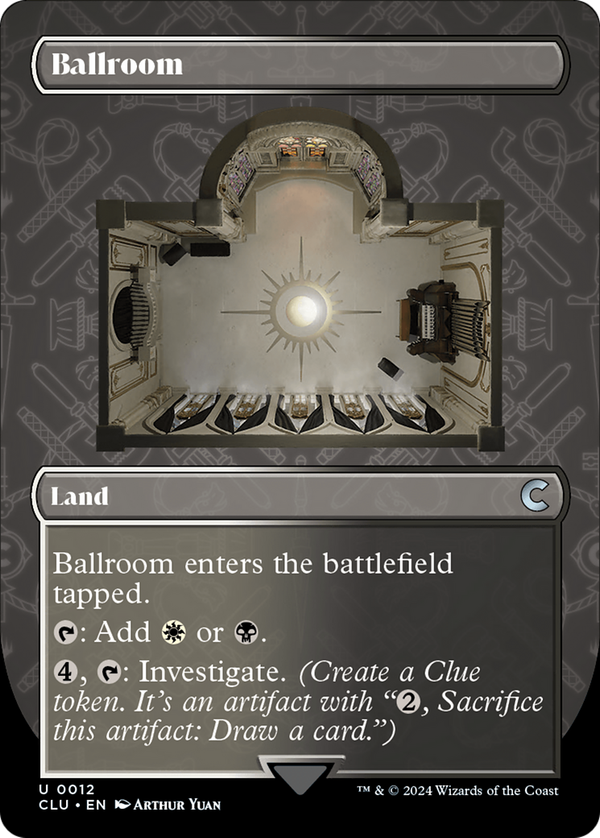
Rules text
 : Add
: Add  or
or  .
.
 , : Investigate. (Create a Clue token. It's an artifact with "
 , Sacrifice this token: Draw a card.")