Baku Altar

The ki counter is the connective tissue of an entire mechanical subtheme, and this artifact is the most literal expression of converting that resource into board presence. Spirits and Arcane spells you cast charge it; spent counters become 1/1 bodies. The conversion rate is deliberately slow: each token costs two mana and a tap on top of the counter, so this was never meant to flood a board in a hurry. The charge and the payout are also strictly one-directional, which is the quiet discipline of the design. The tokens it makes are Spirits, but a token entering is not a cast spell, so the Altar never feeds itself; the counters come only from Spirit or Arcane spells you cast. That separation is what keeps the engine honest. You bank a resource as a byproduct of doing what the deck wants to do anyway, then cash it out into a grind that outlasts decks built on a fixed number of threats. That stacking of resources (cast spell, bank counter, convert counter to creature, repeat) is the heart of how this kind of card was meant to play: a passive accumulator bolted to a sink, neither half worth much without the other. Strip away the tribe and you have a slow token producer priced for an era that valued patience over tempo, the sort of value piece that asks you to build the whole deck around its trigger condition rather than slotting it in for raw rate.
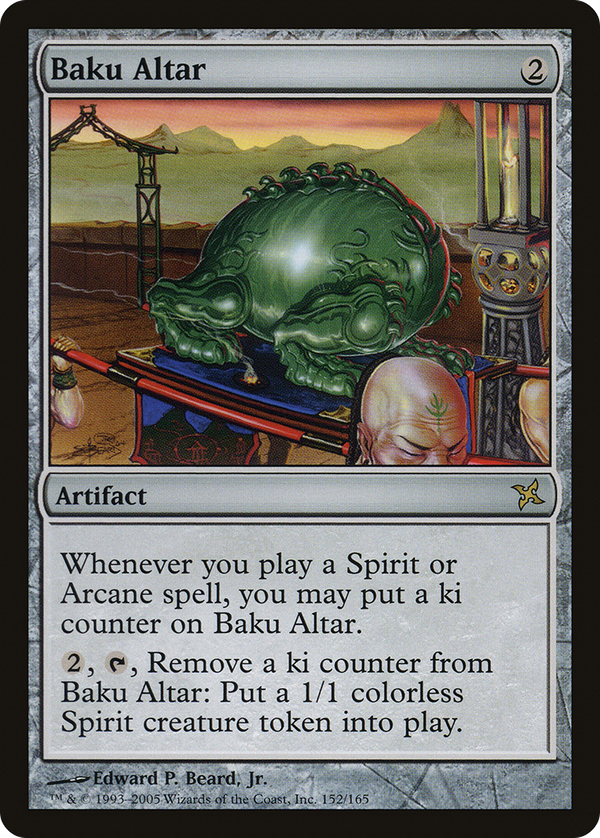
Rules text
,  , Remove a ki counter from this artifact: Create a 1/1 colorless Spirit creature token.