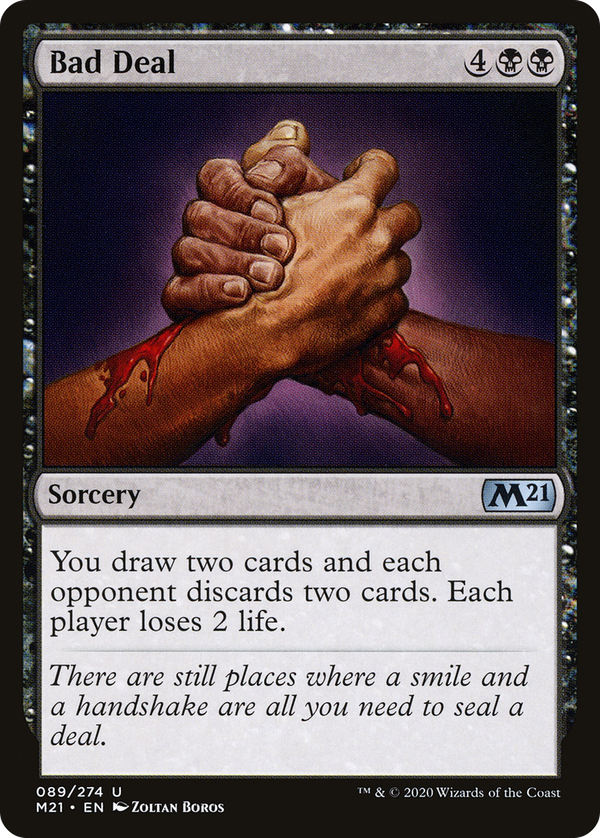
Bad Deal


The trouble with a symmetrical price tag on an asymmetrical effect is that the price stops being a cost and starts being a rounding error. Six mana buys card advantage, hand disruption, and a small life swing all at once: you draw two while each opponent sheds two, and the two life everyone loses is the closest thing to a downside on the card. In a duel that life clause is nearly free, since you are already trading their hand for your draws. Across a full table the effect skews harder in your favor, because the discard clips every opponent while the draws stay yours, and the shared two-life tax barely registers against a pod's worth of resources. This is a black draw-and-discard spell built to punish a wide board of players rather than to win a tight two-person race; the phrase "each opponent" is doing the heavy lifting, and its value scales with the number of hands it can reach into. Plenty of black card-advantage spells have paid a little life for a lot of grip, but most of them pointed their disruption at a single hand and priced themselves to compete in the efficient-value tier. Spreading the discard across the whole table is what pushes this out of that tier and into the slower, grindier register where six-mana sorceries live, where the payoff is measured against the number of opponents rather than the tempo of a single exchange.