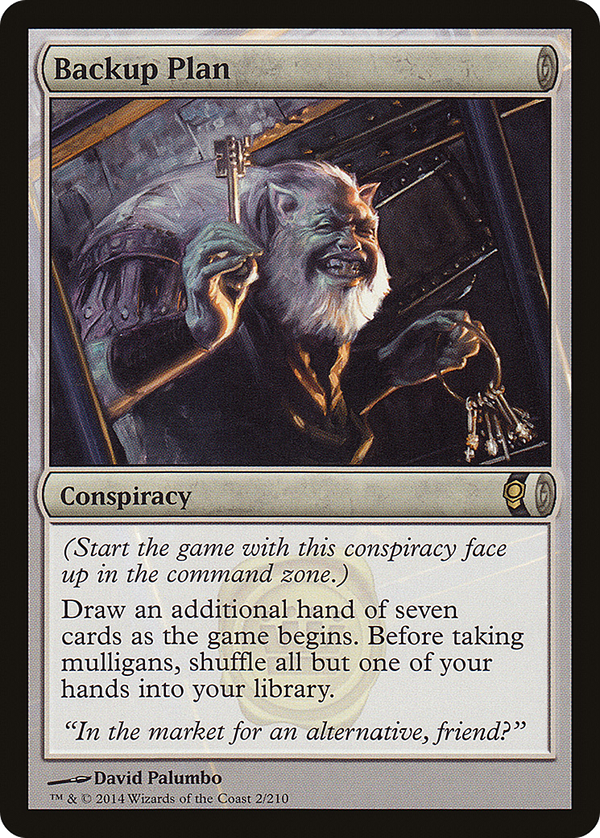
Backup Plan
The mulligan system has always been a tax on variance: keep a hand you don't love because shipping it costs a card, or send it back and dig with one fewer. This conspiracy buys its way around that math entirely by handing you a parallel opening: two hands of seven, look at both, keep the one you'd rather start on, bury the rest before the first mulligan decision even arrives. It is, in pure effect, the single best mulligan a player has ever been offered, because you make the keep-or-toss call with full information about the alternative rather than against an unknown shuffle. The cost is paid up front and outside the game proper: it lives in the command zone as a deck-construction commitment rather than a card you draw, which is precisely what the conspiracy frame exists to permit. The design lesson it surfaces is how brutally a guaranteed seven-card keep warps the early game when consistency is the scarce resource; doubling your odds of a functional opener does more for a combo or a tempo plan than almost any spell you could have drawn instead. That this only ever existed in a draft-and-cube context for multiplayer tables is the leash on it: untethered from those guardrails, the effect is plainly stronger than anything the standard mulligan rules want to allow.