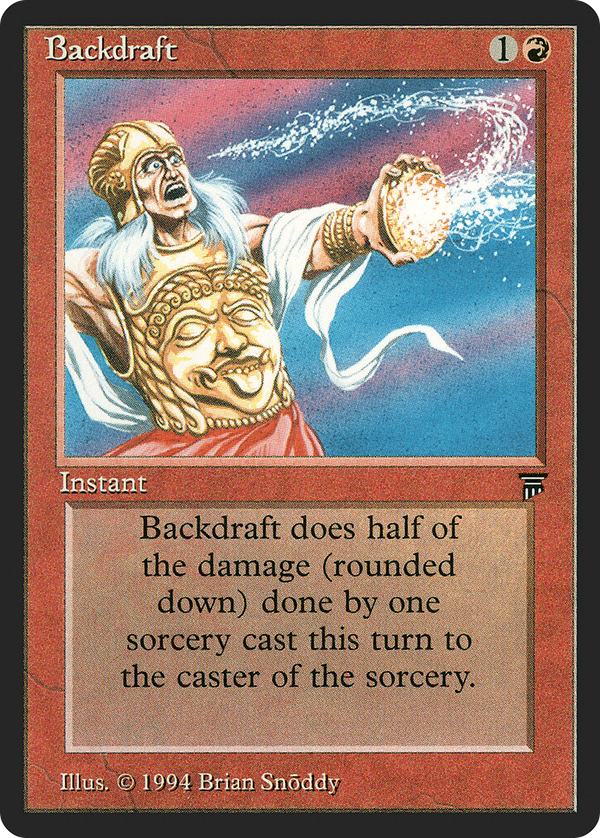
Backdraft


Reactive burn wagered entirely on what the table did this turn: an instant whose payout exists only if a player has already resolved a damage-dealing sorcery, and only then for half of what that sorcery dealt. The choice requirement is deliberately narrow. It is not "a player cast a spell" but "a player cast a sorcery, and that sorcery dealt damage worth halving," which makes this a metagame hoser rather than a flexible burn spell. Fireball and Earthquake are the natural prey; anything that deals no damage (a draw sorcery, a destruction effect) leaves Backdraft dealing zero, so the card demands a sizable damage spell be cast before it does any work at all. The design logic is the mirror-breaker, a category Legends visited often: spells that read as marginal but turn catastrophic when the format's centerpiece is the exact thing being reflected. The halving clause is the brake on the whole thing; you cannot reflect a one-damage burn sorcery into anything meaningful, which forces a real commitment before the punishment bites. And because it only ever points at a player, it is pure reach, never an answer to a creature or a board: its entire job is to turn an offensive sorcery back across the table. It is also an artifact of the period's tolerance for printing spells that simply do nothing against the wrong deck, a design appetite the game has largely retired since.