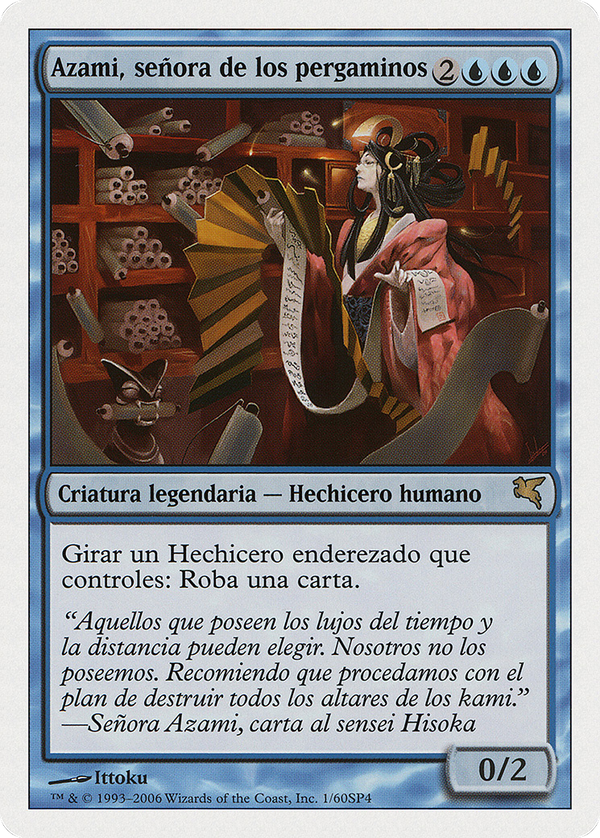
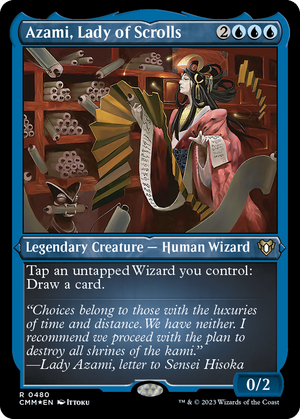
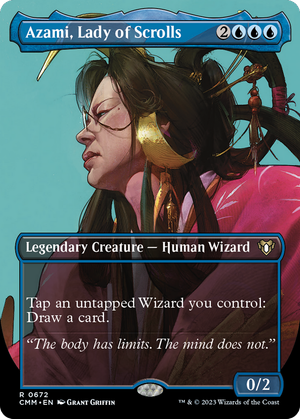
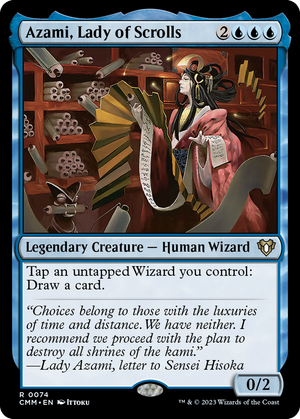
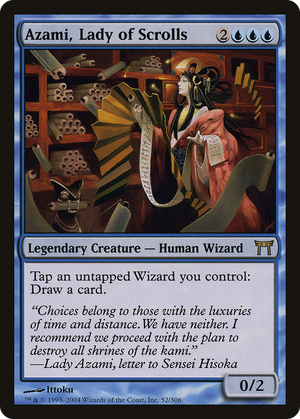
Azami, Lady of Scrolls


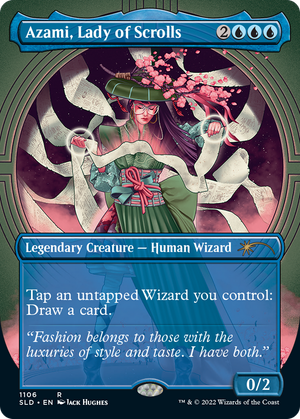
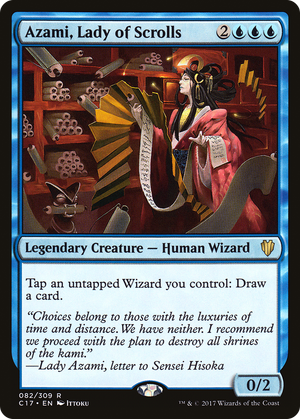
Every Wizard you control is a card waiting to be drawn, and the activation cost is bodies rather than mana: a Wizard's tap pays for a draw, and the only ceiling is how many Wizards you can keep untapped. The crucial wrinkle is that the ability does not use the  symbol in its cost; it asks you to tap an untapped Wizard, which means a creature that arrived this turn still counts. Summoning sickness never gates the engine, so a fresh Wizard off the top can immediately pay into another card. A 0/2 that does nothing in combat is the right shell here, because it asks you to value Wizards for the draws they unlock rather than their power, and it rewards going wide on a single creature type harder than almost any repeatable draw outlet of its era. The legend herself qualifies, so the floor is one card a turn off her own activation, but the design clearly wants a board of mana-producing Wizards and untappers feeding the loop until a deck empties into your hand. This is a tribal payoff built before "tribal" carried the deckbuilding weight it does now: card advantage that scales linearly with commitment and punishes nothing but a board wipe. Where most repeatable draw of the period gated itself behind mana or a discard cost, this gates itself behind creatures you would happily play anyway, which makes the symmetry unusually clean: the more Wizards on the table, the more cards, the bigger the target.