Ayli, Eternal Pilgrim


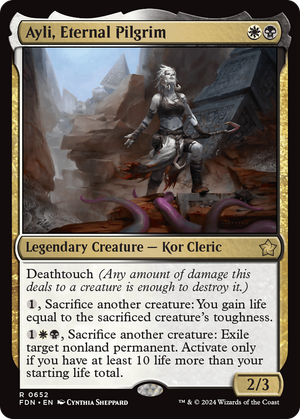
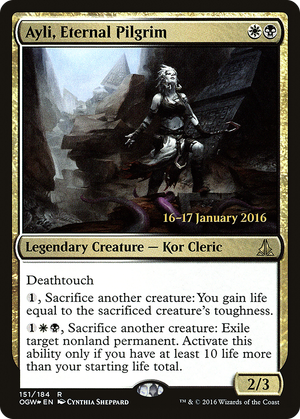
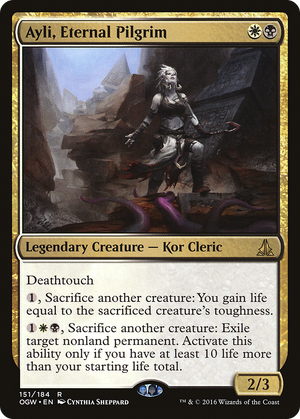
The first sacrifice ability is the workhorse: a repeatable, one-mana outlet that converts a dying creature into life equal to its toughness. That clause exists to feed the second one. The exile ability is gated behind a threshold most decks never approach in a fair game: you need ten more life than you started with before it switches on. So the card is built as a two-stage engine, where the cheap, always-available outlet exists to push your life total into the range where the expensive answer (exile any nonland permanent, repeatable, at a white-black activation cost) comes online. Because neither ability carries a timing restriction, both fire at instant speed: sacrifice in response to removal to bank the life, then exile a blocker mid-combat or a key permanent on an opponent's end step. That design loop, where a lifegain payoff funds an unconditional removal sink, is what made this a foundational lifegain-aristocrats leader rather than just another white-black value creature. Deathtouch on a 2/3 keeps it relevant before the engine assembles, deterring attackers and trading up while you stockpile fodder. The structural cleverness is how tightly the two abilities interlock: the threshold reads as a restriction, but the first ability is purpose-built to clear it, so the gate is less a limit than a ramp. Build the right sacrifice base and the exile loop is not a late-game luxury; it is the natural endpoint of a deck that was gaining life every other turn anyway.
Rules text
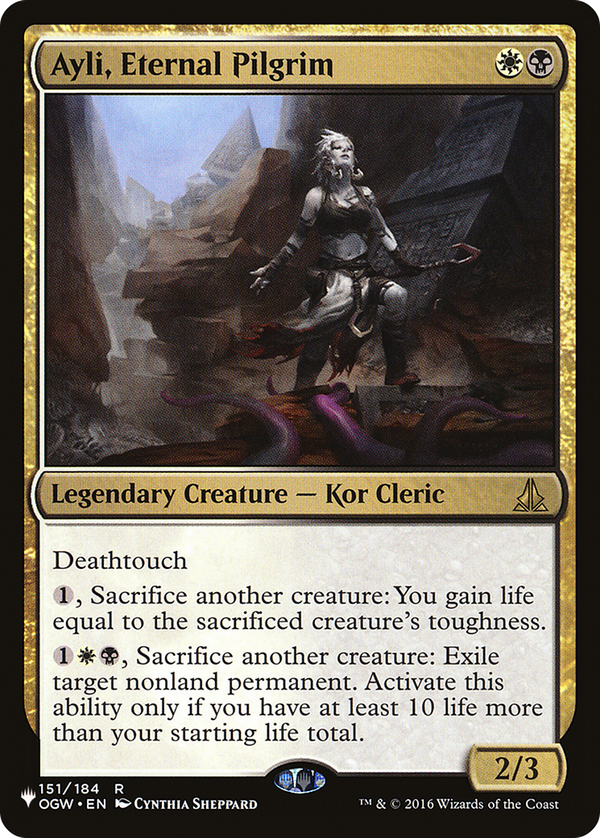
 , Sacrifice another creature: You gain life equal to the sacrificed creature's toughness.
, Sacrifice another creature: Exile target nonland permanent. Activate only if you have at least 10 life more than your starting life total.
, Sacrifice another creature: You gain life equal to the sacrificed creature's toughness.
, Sacrifice another creature: Exile target nonland permanent. Activate only if you have at least 10 life more than your starting life total.