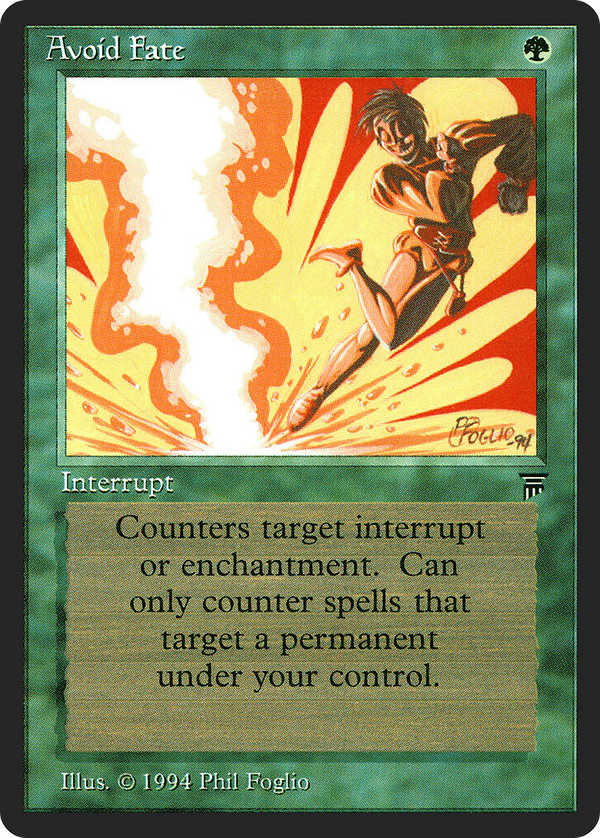
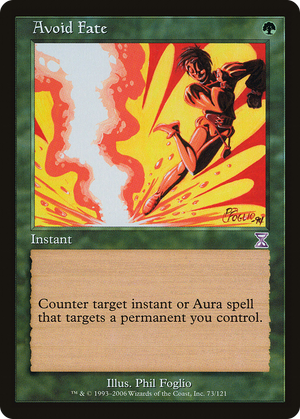
Avoid Fate

Green almost never gets to say no, and the price for breaking that color-pie rule is written into the targeting clause. The counterspell only fires when something is already pointed at one of your permanents, which means it cannot tempo out an opponent's threat, cannot answer a sweeper aimed at the board generally, and cannot interact with sorceries at all. What it does is protect: a Lightning Bolt aimed at your mana dork, an enchantment removal spell aimed at your aura'd-up attacker, a Swords to Plowshares aimed at your fatty. The narrow window is the entire design. Green is allowed to defend its own board because defending the board is what green does in the color pie; what it is not allowed to do is reach across the table and stop the opponent's plan in the abstract. The single-green cost reflects how rarely the window is open. This is one of the game's earliest sketches of a carve-out that designers have returned to for decades: the conditional green answer that turns back targeted removal without violating the rule that green cannot stop spells it has no stake in. Later cards built the same logic into protection effects that shield a permanent or shrug off a kill spell, but the principle starts here, stated cleanly: you may guard what is yours, and nothing more.